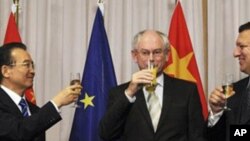
After China met with European Union leaders Wednesday in a one-day summit in Brussels,one major disagreement remained.
European leaders urged China to allow its currency, the yuan, to appreciate more rapidly, just as the United States has urged. But Chinese Premier Wen Jiabao resisted, saying that instead, Europe and the United States should lessen their pressure for China to make such changes.
Mr. Wen said that while some U-S congressmen, among others, have called for a rapid increase in the appreciation of the yuan, there are reasons why it would not be such a good idea.
"If China is going to raise its exchange rates by 20 to 40 percent then many of our export companies will have to close down. Then those enterprise employees will lose jobs and migrant workers will have to return to their villages. That will give rise to social turmoil."
Mr. Wen added that that would not be a good thing for the world economy. China says the problem with trade imbalances between China and Europe, and the U-S, for that matter, has more to do with the structure of their economies than with the yuan exchange rate.
Such words and disagreements along with recent efforts by Japan, South Korea, Taiwan and Thailand, as well as others to weaken their currencies in an attempt to boost exports have led some to suggest there could be what's being termed a global "currency war" brewing.
However, Marc Chandler, chief currency strategist at Brown Brothers Harriman & Company told Bloomberg News there is really no reason for a "currency war."
"I think there's a fundamental difference between China's slowdown, or the currency's rise and trying to knock it down, that is devalue it." "To me," Chandler added, " I'd say there'll be no currency war because these countries that are trying to take action all have rising currencies. All those countries are really talking about is modifying the pace of acceleration."
Mr. Wen's meeting in Brussels is seen as an important precursor to next month's gathering in Seoul, South Korea of the group of 20 wealthy developing nations who will be trying to resolve the major regulatory issues in the aftermath of the 2008 financial crisis. The questions about currency valuations will most likely be high on the G-20 agenda.
New Fears of A "Currency War"