



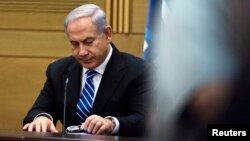
Key parties in Israel have reached an agreement with Prime Minister Benjamin Netanyahu on forming a governing coalition.
The deal signed on Friday has Netanyahu's Likud party alliance partnering with the secular Yesh Atid party, the far-right Jewish Home Party and a small, centrist party headed by former Foreign Minister Tzipi Livni.
Disagreements over the political blocs' division of Cabinet posts had delayed an agreement for weeks.
The new government will face a range of international issues, including the ongoing feud over Iran's nuclear program, less than a week before President Barack Obama is due to arrive in Israel Wednesday March 20.
Philip Wilcox, a former U.S. diplomat in Israel and current president of the Foundation for Middle East Peace in Washington, says the new coalition is likely to pursue the previous government's aggressive stance on the nuclear issue.
"I think it will continue to argue that the possible advent of an Iranian nuclear bomb will create a grave danger to the state of Israel, and therefore if it is clear that Iran has a nuclear capability it should be pre-empted militarily," said Wilcox.
Jonathan Schanzer, vice president of research for the Foundation for Defense of Democracies in Washington, says the new coalition government is not likely to take an active approach in reviving the stalled Palestinian peace process.
"One of the minor players in the coalition, Tzipi Livni, is committed to the peace process, and I think it’s her intention to hold [Prime Minister Netanyahu's] feet to the fire, but she has a very small perch here in this new government," said Schanzer. "The other two real big players here are the Yesh Atid and HaBayit HaYehudi, the Jewish Home Party, and neither one of those parties are particularly fired up about re-igniting the peace process."
Yesh Atid was a surprise performer in Israel's January election, capturing the second-largest number of seats, while support for Netanyahu's party dropped.
The prime minister's bloc, which includes the Yisrael Beitenu party, won the most seats, but not enough to rule on its own.
The new coalition would leave the Labor Party as the largest outside the government, with 15 of the Knesset's 120 seats.
The deal signed on Friday has Netanyahu's Likud party alliance partnering with the secular Yesh Atid party, the far-right Jewish Home Party and a small, centrist party headed by former Foreign Minister Tzipi Livni.
Disagreements over the political blocs' division of Cabinet posts had delayed an agreement for weeks.
The new government will face a range of international issues, including the ongoing feud over Iran's nuclear program, less than a week before President Barack Obama is due to arrive in Israel Wednesday March 20.
Philip Wilcox, a former U.S. diplomat in Israel and current president of the Foundation for Middle East Peace in Washington, says the new coalition is likely to pursue the previous government's aggressive stance on the nuclear issue.
"I think it will continue to argue that the possible advent of an Iranian nuclear bomb will create a grave danger to the state of Israel, and therefore if it is clear that Iran has a nuclear capability it should be pre-empted militarily," said Wilcox.
Jonathan Schanzer, vice president of research for the Foundation for Defense of Democracies in Washington, says the new coalition government is not likely to take an active approach in reviving the stalled Palestinian peace process.
"One of the minor players in the coalition, Tzipi Livni, is committed to the peace process, and I think it’s her intention to hold [Prime Minister Netanyahu's] feet to the fire, but she has a very small perch here in this new government," said Schanzer. "The other two real big players here are the Yesh Atid and HaBayit HaYehudi, the Jewish Home Party, and neither one of those parties are particularly fired up about re-igniting the peace process."
Yesh Atid was a surprise performer in Israel's January election, capturing the second-largest number of seats, while support for Netanyahu's party dropped.
The prime minister's bloc, which includes the Yisrael Beitenu party, won the most seats, but not enough to rule on its own.
The new coalition would leave the Labor Party as the largest outside the government, with 15 of the Knesset's 120 seats.