


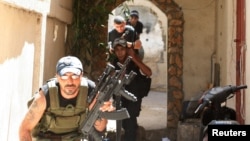
CAIRO — Another round of sectarian fighting broke out in Lebanon's northern coastal city of Tripoli, overnight, between residents of a Sunni Muslim district and their Alawite neighbors. The clashes are raising concerns that sectarian violence in Syria is spilling into Lebanon.
Rounds of automatic weapons were heard throughout the night, as shooting engulfed the front line dividing the Sunni Muslim district of Bab al-Tebbaneh and from the Alawite district of Jebal Mohsen.
It was the fourth consecutive day of sporadic clashes between the rival communities.
Witnesses say fighting tapered off Friday morning as shops opened in most parts of Tripoli. A number of shops were set ablaze overnight in apparent acts of revenge. Sunni Sheikh Khaled al-Baradei was killed in the latest fighting, exacerbating tensions.
One Sunni Muslim fighter told journalists that it was the Alawites who broke the latest cease-fire between the warring communities:
He complains that both sides agreed to a simultaneous cease-fire Thursday, but that the Alawite side did not respect it.
As both sides point blame, Lebanese Prime Minister Najib Mikati said at a news conference that political leaders have been working to put out the flames of sectarian conflict:
He says that negotiations have continued since the first day (of the fighting) and that meetings were undoubtedly behind the cease-fire that (broke down overnight). He stresses that all political forces in Lebanon are giving their support to the Lebanese Army.
Hilal Khashan, who teaches political science at the American University of Beirut, says the fighting could be linked to attempts to open a military airport in northern Lebanon to civilian use.
"Following the repeated closures of the airport road in Beirut over the past weeks, there have been talks about the need to open an alternative airport and members of the March 14th [anti-Syrian] Coalition have been talking about opening the Kleyat Airport in the north. Of course, for that airport to become functional you need to disarm the Alawites in Jebal Mohsen because they overlook the highway leading to the north," said Khashan.
The old Kleyat military airport lies 10 kilometers south of the Syrian border.
Pro-Syrian supporters have repeatedly closed the road from Beirut's international airport leading into the capital. They have also kidnapped a number of Syrian citizens in reprisal for Lebanese Shi'ites being held by the rebel Free Syrian Army.
The Alawites of Tripoli's Jebl Mohsen district support Syria's Alawite-led regime of President Bashar al-Assad. They are also allies of the militant/political faction Hezbollah in a broad pro-Syrian coalition which currently governs Lebanon.
Analysts estimate the strength of the Alawite community in Tripoli at around 40,000 to 50,000 people in a city with 200,000 inhabitants.
Rounds of automatic weapons were heard throughout the night, as shooting engulfed the front line dividing the Sunni Muslim district of Bab al-Tebbaneh and from the Alawite district of Jebal Mohsen.
It was the fourth consecutive day of sporadic clashes between the rival communities.
Witnesses say fighting tapered off Friday morning as shops opened in most parts of Tripoli. A number of shops were set ablaze overnight in apparent acts of revenge. Sunni Sheikh Khaled al-Baradei was killed in the latest fighting, exacerbating tensions.
One Sunni Muslim fighter told journalists that it was the Alawites who broke the latest cease-fire between the warring communities:
He complains that both sides agreed to a simultaneous cease-fire Thursday, but that the Alawite side did not respect it.
As both sides point blame, Lebanese Prime Minister Najib Mikati said at a news conference that political leaders have been working to put out the flames of sectarian conflict:
He says that negotiations have continued since the first day (of the fighting) and that meetings were undoubtedly behind the cease-fire that (broke down overnight). He stresses that all political forces in Lebanon are giving their support to the Lebanese Army.
Hilal Khashan, who teaches political science at the American University of Beirut, says the fighting could be linked to attempts to open a military airport in northern Lebanon to civilian use.
"Following the repeated closures of the airport road in Beirut over the past weeks, there have been talks about the need to open an alternative airport and members of the March 14th [anti-Syrian] Coalition have been talking about opening the Kleyat Airport in the north. Of course, for that airport to become functional you need to disarm the Alawites in Jebal Mohsen because they overlook the highway leading to the north," said Khashan.
The old Kleyat military airport lies 10 kilometers south of the Syrian border.
Pro-Syrian supporters have repeatedly closed the road from Beirut's international airport leading into the capital. They have also kidnapped a number of Syrian citizens in reprisal for Lebanese Shi'ites being held by the rebel Free Syrian Army.
The Alawites of Tripoli's Jebl Mohsen district support Syria's Alawite-led regime of President Bashar al-Assad. They are also allies of the militant/political faction Hezbollah in a broad pro-Syrian coalition which currently governs Lebanon.
Analysts estimate the strength of the Alawite community in Tripoli at around 40,000 to 50,000 people in a city with 200,000 inhabitants.