



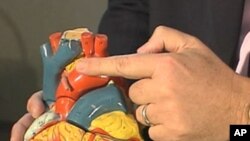
The American Heart Association reports that the death rate from diseases affecting the heart and blood vessels has dropped by almost 30 percent since the 1990's. Still, heart disease remains a major killer in the United States. It is what claimed the life of US diplomat Richard Holbrooke, who died of a burst aorta December 13.
The aorta is the biggest artery in the body. It travels from the heart to the abdomen and carries blood to the other organs and other arteries. Healthy arteries are smooth and elastic, but in a weak one, blood flowing through can cause it to form a bulge. If that bulge tears open, chances of survival are slim.
There are few symptoms beforehand and even with immediate medical treatment, only a small percentage patients survive. Risk factors include age.
Dr. Richard Rubin, the chief cardiologist at Sibley Hospital in Washington, said, "As we get older, the aorta gets a little more brittle. Forces like high blood pressure and athrosclerotic plaque in the arteries can weaken the wall of the aorta and make it more brittle, and then at some point, if the pressure is excessive, it can rupture."
There are other factors, such as excessive weight or sudden bursts of energy.
"What is especially dangerous is a sudden surge in the pressure, for example, when you are shoveling snow or if somebody askes you to move a piece of furniture and you give a tremendous exertion, your blood pressure can skike up suddenly, and that can be especially tearing to the wall of the aorta," said Dr. Rubin.
Aneurysms can be detected by X-ray or by imaging techniques such as an echocardiogram, an MRI (magnetic resonance imaging) or a CT scan. That's how Kevin Healey's doctor detected his aneurysm two years ago.
"He did an echogram, and noticed an irregularity in the size of the heart. So he followed that up with a CT scan and found an aneurysm on the aorta," said Healey.
Doctors repaired Healey's aneurysm, but Dr. Rubin explains that when the aneurysm suddenly bursts, the situation becomes a life-or-death emergency. "When this happens, the volume of blood in your body gets dumped into the chest cavity or the abdominal cavity, and that is a medical emergency. Your blood will leak out, your blood pressure will drop, and then all of the vital organs of the body will not receive the proper amount of blood because it has leaked out through the tear," he said.
Doctors can cut out the aneurysm and replace it with a patch or artificial piece of blood vessel. Some Australian doctors have devised a way to repair an aneurysm without major surgery.
Dr. Tony Grabs performs this procedure at St. Vincent's Hospital in Sydney. "The significant improvement in the design, the technology, has enabled us to undertake this operation really from two small cuts in the groin and also a small cut in the arm to get access to the arteries. So it really is revolutionary and changes the whole way that certainly I think about the treatment of aneurysms," he said.
While age can be a factor, doctors say keeping your cholesterol, blood pressure and weight within normal limits can help keep your aorta healthy and reduce your chances of having an aneurysm.