The debt-ridden Spanish government and the country's troubled economy are the newest face of the European debt crisis.
Stock markets across Asia, Europe and the United States plunged on Monday on fears that Madrid will need an international bailout after the country's borrowing costs soared above the level at which Greece, Ireland and Portugal all were forced to secure rescue packages.
Economy minister Luis de Guindos denied that Spain would need help beyond the $122 billion package Europe has already sanctioned for the ailing Spanish banking system.
But as Spain's autonomous regions sought new assistance from the central government for their own debt woes, interest rates on Spanish debt jumped to more than 7.5 percent, the country's highest level in the 13-year history of the euro currency union. The interest rate is well above the seven percent level that pushed the Greek, Irish and Portuguese governments into bailouts.
Spain's stock market fell sharply Monday for the second straight day of trading. Officials attempted to curb the freefall, banning the practice of short-selling of financial stocks for three months, on the theory that it contributes to a declining market. In short-selling, investors bet that the price of stocks will fall, borrowing stock from a broker, selling it, and then attempting to buy it back at a cheaper price, to pocket the difference.
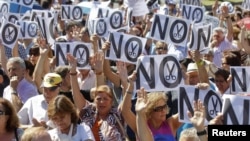
Spain has imposed sharp austerity measures, cutting government spending and increasing taxes. Thousands of workers have taken to the streets in recent days in protest, but the government says the changes are necessary to rein in the government's deficit.
The underlying problem for Spain is its weak economy. Spain has the fourth largest economy in the 17-nation eurozone, but about a fourth of its workers are unemployed.
Its economy also is contracting, not growing. In a new report, the central bank said the country's economy shrunk four-tenths of a percent in the April-to-June period, with the government predicting that the decline will continue into next year.
Additionally, there is renewed eurozone attention on Greece and Italy.
Auditors from the European Union, the European Central Bank and the International Monetary Fund are gathering in Athens to take a new look at the government's efforts to impose budget cuts so it can receive more money from the country's second bailout in two years.
Greek Prime Minister Antonis Samaras on Sunday compared the financial woes of his country to that of the United States during its Great Depression in the 1930s.
Italy, another country with burgeoning debt, also is facing an increase in its borrowing costs.
Economics professor Nicola Borri said the Spanish economic upheaval has directly affected the interest rate Rome is paying on its debt.
"So it is not clear right now, if the 100 billion euros that Europe has pledged to save Spanish banks will be able to stop the banking crisis that is right now happening in Spain, and it is not clear yet which is the real trouble in the Spanish provinces. So I think that this uncertainty at the Spanish level is definitely affecting our market as well," said Borri.
Stock markets across Asia, Europe and the United States plunged on Monday on fears that Madrid will need an international bailout after the country's borrowing costs soared above the level at which Greece, Ireland and Portugal all were forced to secure rescue packages.
Economy minister Luis de Guindos denied that Spain would need help beyond the $122 billion package Europe has already sanctioned for the ailing Spanish banking system.
But as Spain's autonomous regions sought new assistance from the central government for their own debt woes, interest rates on Spanish debt jumped to more than 7.5 percent, the country's highest level in the 13-year history of the euro currency union. The interest rate is well above the seven percent level that pushed the Greek, Irish and Portuguese governments into bailouts.
Spain's stock market fell sharply Monday for the second straight day of trading. Officials attempted to curb the freefall, banning the practice of short-selling of financial stocks for three months, on the theory that it contributes to a declining market. In short-selling, investors bet that the price of stocks will fall, borrowing stock from a broker, selling it, and then attempting to buy it back at a cheaper price, to pocket the difference.
Spain has imposed sharp austerity measures, cutting government spending and increasing taxes. Thousands of workers have taken to the streets in recent days in protest, but the government says the changes are necessary to rein in the government's deficit.
The underlying problem for Spain is its weak economy. Spain has the fourth largest economy in the 17-nation eurozone, but about a fourth of its workers are unemployed.
Its economy also is contracting, not growing. In a new report, the central bank said the country's economy shrunk four-tenths of a percent in the April-to-June period, with the government predicting that the decline will continue into next year.
Additionally, there is renewed eurozone attention on Greece and Italy.
Auditors from the European Union, the European Central Bank and the International Monetary Fund are gathering in Athens to take a new look at the government's efforts to impose budget cuts so it can receive more money from the country's second bailout in two years.
Greek Prime Minister Antonis Samaras on Sunday compared the financial woes of his country to that of the United States during its Great Depression in the 1930s.
Italy, another country with burgeoning debt, also is facing an increase in its borrowing costs.
Economics professor Nicola Borri said the Spanish economic upheaval has directly affected the interest rate Rome is paying on its debt.
"So it is not clear right now, if the 100 billion euros that Europe has pledged to save Spanish banks will be able to stop the banking crisis that is right now happening in Spain, and it is not clear yet which is the real trouble in the Spanish provinces. So I think that this uncertainty at the Spanish level is definitely affecting our market as well," said Borri.