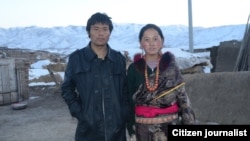
This citizen journalist photograph shows Lhamo Tseten, who self-immolated, October 26, 2012, in Sangchu county, and his wife Tsering Lhamo.
Anger and despair appear to be consuming Tibetan areas of China, where at least four more Tibetans have set themselves on fire to protest Chinese rule.
The most recent self-immolation took place Friday night in Sankok township in Sangchu county, in China's northwestern Gansu province. A photo obtained by VOA Tibetan shows 23-year-old Tsepak Kyap engulfed in flames near a bus stop.
Witnesses say Kyap suffered severe burns. It is not known if he survived. Sources say he was married to an 18-year-old wife, Dorje Dolma.
Earlier Friday, 24-year-old Lhamo Tseten died after walking out of a restaurant and setting himself on fire in Amchok township in Sangchu county.
Following Tseten's self-immolation, the London-based rights group Free Tibet said there were reports of Chinese security forces quickly moving into the area.
The 23-year-old Tibetan man, Tsepak Kyap, is seen here engulfed in flames near a bus stop in the township of Sankok, Sangchu county, in China’s northwestern Gansu province. This photo was sent into to the VOA Tibetan Service.
With Friday's two, new self-immolations, there have now been five such protests in Gansu province in just the past week.
VOA Tibetan has also learned of two more self-immolations Thursday in Nagchu, in what China has designated as the Tibet Autonomous Region.
One of the protesters, Tsebup, reportedly died after setting himself on fire near the Bangar Monastery in Naro township. The fate of the second protester was not immediately known.
Since February of 2009, at least 62 Tibetans have set themselves on fire to protest Chinese policy in Tibet. In 50 cases the protesters have died.
The large number of self-immolations has prompted Chinese police to offer cash rewards to anyone who provides information on people planning to set themselves on fire.
But Harriet Beaumont, with the London-based rights group Free Tibet, says there is nothing to suggest any the protests are anything more than individual acts.
"We have no evidence whatsoever in the last 18 months of self-immolations that there has been any prior knowledge or involvement in the planning of these acts by anybody other than the people who have set fire to themselves," said Beaumont. "So we're extremely concerned at this method, because there have been some cases where people have been convicted and given long sentences after being accused of involvement in the planning of these acts."
China has long accused Tibetan exiles of self-immolating as part of a separatist struggle, denouncing them as terrorists.
VOA's Tibetan service reported earlier on the offer of cash rewards Tuesday in China's Gannan prefecture, called Kanlho prefecture by Tibetans. A photo obtained by VOA shows one notice posted on a poll. It says police will pay $8,000 to anyone who provides information "on the people who plan, incite to carry out, control and lure people to commit self-immolation."
A translation by the International Campaign for Tibet says the notices also decry self-immolation as "an extreme action against human beings, against society" and warns would-be protesters such actions "are ungrateful of how your parents raised you."
The announcement also promises a reward of about $30,000 to anyone who gives any credible information about the region's four most recent self-immolations.
The Voice of America provides news and information in more than 40 languages to an estimated weekly audience of over 326 million people. Stories with the VOA News byline are the work of multiple VOA journalists and may contain information from wire service reports.