


News / Middle East

Newsmaker: Can Israeli, Palestinian Youth Revive Peace Process?

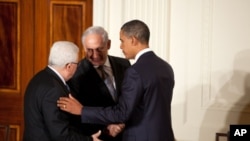
President Barack Obama talks with Palestinian President Mahmoud Abbas and Prime Minister Benjamin Netanyahu of Israel at the conclusion of a statement to the press in the East Room of the White House, September 1, 2010
TEXT SIZE - +
Davin Hutchins

Moribund. Fallow. Stale. These are the words observers are using to describe the Israeli-Palestinian peace process in 2011. Prime Minister Benjamin Netanyahu is reluctant to re-enter talks now that the Palestinian Authority and Hamas have formed a tenuous unity government. Likewise, Palestinian negotiators are skeptical that the Israeli government has the political will to halt settlements in the West Bank long enough to negotiate in good faith. Direct negotiations ceased back in September 2010 and agreement over so-called “final status” issues seems far over the horizon.

OneVoice CEO Howard Sumka talks about the role youth may play in reviving Middle East peace process:

Now, the Palestinians seem emboldened enough to go it on their own. The Palestinian Authority says it will go to the United Nations in September and ask for recognition of an independent state in the West Bank, Gaza Strip and East Jerusalem, a move opposed by both Israel and the United States.

This week, leaders in Ramallah confirmed they will seek recognition based on pre-1967 borders, membership in the United Nations and acknowledgment of the right to self-determination in accordance with the U.N. charter.

Sixty-five percent of Palestinians say they support the Palestinian Authority's plan to seek statehood in the United Nations this September, according to a new poll conducted by the Palestinian Center for Policy and Survey Research in Ramallah.  As Palestinians consider their options to gain recognition from the world community on their own, many are asking if that is the right path to pursue without a negotiated settlement with Israel.
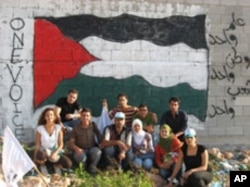
Some of the youth leadership trainees affiliated with the OneVoice Movement in Israel and the occupied Palestinian territories

OneVoice Movement has been working for nearly a decade with both Israeli and Palestinian youth through town meetings and leadership programs to educate both sides on how key final-status issues can be addressed and how negotiations - if restarted - can lead to a lasting peace.

VOA’s Davin Hutchins sat down with OneVoice CEO Howard Sumka to talk about the role youth may play in reigniting a stagnant peace process between Israel and the Palestinians. Sumka spent 25 years with the United States Agency for International Development (USAID) before joining OneVoice, most recently as mission director of the West Bank and Gaza.

He says younger members of both Palestinian and Israeli society are not as jaded as older generations and the climate of youth empowerment in this age of the Arab Spring could inspire a real breakthrough.
Follow our Middle East reports on Twitter
and discuss them on our Facebook page.

You May Like

Experts Weigh In on Challenges of Closing Guantanamo Prison

Former chief military prosecutor at Guantanamo delivers petition to White House with more than 370,000 signatures, demanding facility be closed down immediately More

Karzai to Discuss Enhancing Defense Ties with India

Afghanistan looking for more military aid as it prepares for withdrawal of NATO forces by next year More

India, China Pledge to Overcome Border Tensions

Indian prime minister and Chinese premier attempt to move past tense standoff in the Himalayas during Delhi talks More

Burmese President Opens US Visit with VOA Town Hall Meeting

Ahead of his meeting with President Obama Monday, Thein Sein answered questions on human rights and economic development in his country More

This forum has been closed.
Comments
     
There are no comments in this forum. Be first and add one

Featured Videos

Your JavaScript is turned off or you have an old version of Adobe's Flash Player. Get the latest Flash player.
Video

Video US Oil Surge Could Impact Mideast Geopolitics

The United States will account for a third of new oil supplies over the next five years, and will become energy self-sufficient in 20 years, according to a new report by the Paris-based International Energy Agency (IEA). Although U.S. oil imports from Arab Gulf countries increased last year, analysts predict the U.S. will lose its dependence on Middle East imports, which is expected to have a huge impact on international relations and the balance of power. VOA's Henry Ridgewell reports.