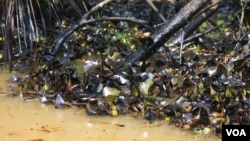
Oil coats the plants along the banks of many of the Niger Delta waterways. Locals say they catch roughly 80 percent less fish than they did five years ago. (Heather Murdock for VOA)
WARRI, NIGERIA — Environmental damage from oil spills in Nigeria's Niger Delta region has reached epic proportions and continues to threaten the stability of Africa’s most populous nation. Locals say people are dying young or fleeing the region while oil companies and corrupt officials get rich on their resources. However, oil companies say sabotage of their facilities accounts for 75 percent of the spills.
Before the war and before there was oil, the Niger Delta must have looked like paradise. Even today it’s beautiful. One of the most bio-diverse parts of Africa, the creeks and rivers are like a spider web on top of a lush swampy jungle.
Only now if you look closely, you see that black oil coats the roots of the mangroves and floats in the water. For local residents, the consequences are disastrous.
These people are standing on a dock by their village. All of them and all of their ancestors fish for a living-or at least they used to, before the oil killed the fish. In the past five years, they say, their catches have reduced about 80 percent.
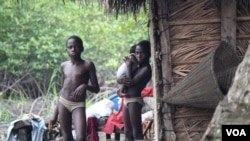
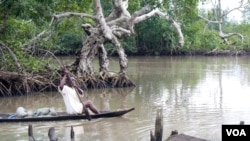
Decent Victor lives in another village on the riverbank. She says the children here are constantly sick from drinking water polluted with oil and the nearest hospital in the city of Warri is five to six hours away in a dug out canoe - their only means of transportation.
In fishing villages along the creeks in the Niger Delta, locals say children are constantly sick from drinking water polluted by oil. (Heather Murdock for VOA)
“If you see a 10- years [- old] child getting that sickness, and you carry this boy to the hospital before getting to Warri the child died,” said Victor.
Amnesty International says between nine and 13 million barrels of oil has been dumped in the Niger Delta’s creeks, rivers and in the gulf over the past 50 years. They say it is comparable to having an annual Exxon Valdez-size disaster for decades.
Lawyer Clarkson Money Aribogha advocates for hundreds of communities that say they are suffering from oil spills. He says large oil companies are slow to investigate and often declare areas have not been impacted without visiting the villages.
"It is apparently clear that oil affected these people,” said Aribogha. "You have not visited the place. How do you know that oil has not reached that place? How do you know that only four communities have got to deal with it. For such a major oil spill?"
Government officials say oil companies by law have to financially compensate spill victims. But before people can get any money, they have to prove the oil coating the plants and floating in the drinking water came from a specific spill.
Benjamin Olubunmi Akindele, who heads the Warri office of the National Oil Spill Detection and Response Agency, says oil companies are also responsible for clean-up, not the government. He says the two entities work together to investigate claims.
“We are going out there to every nook and cranny,” said Akindele. "As long as you complain you must be listened to. Listening means investigation and seeing whether your fears or your allegations are genuine."
In the fishing villages along the creeks, locals say it can take six hours to paddle to the nearest hospital and that sick children often don't survive the ride. (Heather Murdock for VOA)
However, oil companies say they are not responsible for most of the spills. They say most are a result of sabotage - meaning oil theft and illegal refineries. They complain the government does not do enough to protect their operations.
Casely Omon Ihabor is a lawyer representing a currently demobilized militant group that is threatening future attacks. He says insurgents laid down their weapons in exchange for amnesty in 2009 but it should have been the oil companies and the government asking for pardons.
“You have destroyed the ecology,” said Ihabor. "You have destroyed the waters. You have destroyed the fish. You have killed people. We have children and widows and orphans roaming about the streets. You grant amnesty? It should have been the other way round. You should have apologized to the Niger Delta. Not you grant the amnesty.”
With everyone blaming and no one taking responsibility, it’s difficult to imagine a fast solution. Companies say people need to stop stealing oil. Activists accuse companies of inflating theft numbers and dumping oil without concern for the people.
And government officials say polluters are in charge of cleaning up their own messes.