


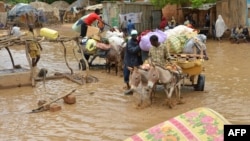
The worst flooding in 80 years is affecting over 500,000 people in Niger. International aid agency Oxfam said floodwaters in and around Niamey have unrelentingly been rising since July, when the rains began, destroying homes and over 7,000 hectares of crops.
The U.N. Office for the Coordination of Humanitarian Affairs reports it is estimated that more than 80 people have died as a direct result of the floods.
Oxfam has called for immediate assistance to scale up efforts to help the most vulnerable families survive yet another crisis.
The floods are occurring at a time when Niger is trying to recover from drought that had spread throughout the Sahel region earlier in the year. The drought caused a hunger crisis that affected more than half a million people in the country. It also brought on cholera which has killed so far 96 people.
“Niger is going through a very challenging time during this period of flooding because Niger is already facing the food crisis that started earlier this year affecting more than 5.5 million people,” said Valerie Batselaere, the media lead for Oxfam in Niamey.
She said thousands of people have been forced from their homes because houses have crumbled under pressure from the rains and flooding.
Oxfam, which already had a presence in Niger, has responded to the flooding with a number of distributions to flood affected people in Niamey, Tilllabery, Zinder and Maradi.
“The items Oxfam is distributing include buckets; mosquito nets, masks, blankets and together with other organizations who are distributing cash transfers for example, we are trying to cover the needs of the most affected people,” said Batselaere.
Oxfam said many families have sought refuge in schools, in and around Niamey. Batselaere said this is causing a very big problem because this is the beginning of a school year that has been delayed by two weeks so far. Also, once the families are provided with shelter, the government has to work to return the schools to their proper condition.
“Classrooms are not in the same condition anymore, after the families leave. So it is quite the burden on the students whose school year is being delayed,” said Batselaere.
Niger’s government is working along with humanitarian organizations to rehabilitate the schools for the students.
To listen to the entire interview with Kim Lewis and Valerie Batselaere, please click on audio.
The U.N. Office for the Coordination of Humanitarian Affairs reports it is estimated that more than 80 people have died as a direct result of the floods.
Oxfam has called for immediate assistance to scale up efforts to help the most vulnerable families survive yet another crisis.
The floods are occurring at a time when Niger is trying to recover from drought that had spread throughout the Sahel region earlier in the year. The drought caused a hunger crisis that affected more than half a million people in the country. It also brought on cholera which has killed so far 96 people.
“Niger is going through a very challenging time during this period of flooding because Niger is already facing the food crisis that started earlier this year affecting more than 5.5 million people,” said Valerie Batselaere, the media lead for Oxfam in Niamey.
She said thousands of people have been forced from their homes because houses have crumbled under pressure from the rains and flooding.
Oxfam, which already had a presence in Niger, has responded to the flooding with a number of distributions to flood affected people in Niamey, Tilllabery, Zinder and Maradi.
“The items Oxfam is distributing include buckets; mosquito nets, masks, blankets and together with other organizations who are distributing cash transfers for example, we are trying to cover the needs of the most affected people,” said Batselaere.
Oxfam said many families have sought refuge in schools, in and around Niamey. Batselaere said this is causing a very big problem because this is the beginning of a school year that has been delayed by two weeks so far. Also, once the families are provided with shelter, the government has to work to return the schools to their proper condition.
“Classrooms are not in the same condition anymore, after the families leave. So it is quite the burden on the students whose school year is being delayed,” said Batselaere.
Niger’s government is working along with humanitarian organizations to rehabilitate the schools for the students.
To listen to the entire interview with Kim Lewis and Valerie Batselaere, please click on audio.
