



News / Africa

Niger to Begin Campaigning Ahead of January Elections

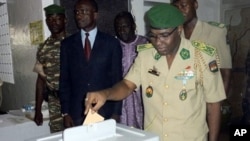
The head of the military junta, General Salou Djibo, casts his ballot in Niamey as Niger voted today in a constitutional referendum, 31 Oct 2010

Multimedia

Audio
  • Bazoum Mohammed, a prominent member of Niger’s Consultative Council and vice president of the Nigerien Party for Democracy and Socialism (PNDS-Tarayya), spoke with Clottey

TEXT SIZE - +
Peter Clottey

A prominent member of Niger’s Consultative Council said the country’s political parties will soon begin official campaigning ahead of next year’s presidential and parliamentary elections scheduled for 31st January.

Bazoum Mohammed, who is also vice president of the Nigerien Party for Democracy and Socialism (PNDS-Tarayya), the country’s biggest political party, told VOA there is unanimous agreement among all political parties to ensure the elections are credible.

“For the local (election), the campaigning will begin on the 30th of this month and we will have one week of campaigning. And, for the presidential and parliamentary election, it will begin on the 9th of January and we will have three weeks for the campaigning.”

This came after Niger’s Constitutional Court approved 10 presidential candidates to participate in the vote.

The presidential aspirants approved by the court include former Prime Minister Hama Amadou of the Nigerien Democratic Movement (MDN), Mahamane Ousmane of the Niger Progressive Party (CDS), Mahamadou Issoufou of the PNDS-Tarayya party, as well as Bayard Mariama Gamatie, the country’s first female presidential aspirant.

The presidential election will return Niger to constitutional rule after the military removed former President Mamadou Tandja from power in February.

Mr. Tandja drew sharp criticism from the international community after he amended the constitution to extend his mandate after serving two consecutive five-year terms as allowed in the constitution.

Mohammed said Nigeriens are excited about the prospects of voting in a democratic election to choose their own leaders.

“Nigeriens are very happy to have (a) free election and they are confident in the electoral commission. And, we think that everything will go (smoothly) and we are very confident in our (country’s) future. We think that we will have new and stable institutions, (which) will be good for our country,” said Mohammed.

He further said that the country lost its place within the international community after the coup d’état.

“Niger has been excluded from many regional and international institutions. And now, when we have (restored) the rule of law, we know that we will be accepted everywhere,” said Mohammed.

You May Like

Experts Weigh In on Challenges of Closing Guantanamo Prison

Former chief military prosecutor at Guantanamo delivers petition to White House with more than 370,000 signatures, demanding facility be closed down immediately More

Karzai to Discuss Enhancing Defense Ties with India

Afghanistan looking for more military aid as it prepares for withdrawal of NATO forces by next year More

India, China Pledge to Overcome Border Tensions

Indian prime minister and Chinese premier attempt to move past tense standoff in the Himalayas during Delhi talks More

Burmese President Opens US Visit with VOA Town Hall Meeting

Ahead of his meeting with President Obama Monday, Thein Sein answered questions on human rights and economic development in his country More

This forum has been closed.
Comments
     
There are no comments in this forum. Be first and add one

Featured Videos

Your JavaScript is turned off or you have an old version of Adobe's Flash Player. Get the latest Flash player.
Video

Video US Oil Surge Could Impact Mideast Geopolitics

The United States will account for a third of new oil supplies over the next five years, and will become energy self-sufficient in 20 years, according to a new report by the Paris-based International Energy Agency (IEA). Although U.S. oil imports from Arab Gulf countries increased last year, analysts predict the U.S. will lose its dependence on Middle East imports, which is expected to have a huge impact on international relations and the balance of power. VOA's Henry Ridgewell reports.