


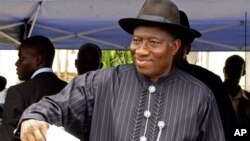
Nigerian President Goodluck Jonathan’s pardons last week of four individuals, including former Bayelsa State Governor Diepreye Alamieyeseigha, continue to stir negative reaction.
U.S. State Department spokesperson Victoria Nuland described the pardons as a setback in the fight against corruption.
The Council of Ogoni Professionals International, a Nigerian diaspora group in the United States, also disagreed with the pardons.
Council member Anslem John-Miller said, instead of pardoning corrupt officials and giving amnesty to militants, Jonathan should have called for a judicial review of the trial and conviction of environmentalist Ken Saro-Wiwa.
Saro-Wiwa and his Movement for the Survival of Ogoni People (MOSOP) campaigned for greater control over oil and gas resources on Ogoni land and against environmental devastation.
Saro-Wiwa and eight other Ogonis were executed in 1995. John-Miller said he contributed to the restoration of democracy in Nigeria.
"It’s not that we are totally against individuals being pardoned by the federal government, but we feel that individuals who have been convicted of a certain crime, particularly corruption, should have been made to face the consequences of their actions so as to serve as a deterrence to others," he said.
John-Miller said, by pardoning people like Alamieyeseigha, the federal government is leaving an impression that it is not serious about the country’s ongoing fight against corruption.
Doyin Okupe, Jonathan’s senior special assistant on public affairs was quoted as saying that Alamieyeseigha had been adequately punished for his action, and that he had been playing a quiet role in helping to stabilize the volatile Niger Delta region.
"You don’t just jump up to pardon people. There should have been a judicial panel to review the charges against the individual and then, on the basis of the recommendation of the judicial panel, the charges can then be dismissed or those individuals can be pardoned," John-Miller said.
He said Jonathan should have called for a judicial review of the case of Saro-Wiwa and the eight other Ogonis.
“This was a man [Saro-Wiwa] and other Ogonis who were killed unjustly by the Abacha military regime. In fact, the issue of the Niger Delta is where it is today because of the effort of Ken Saro-Wiwa. And it is an indisputable fact, and undeniable fact, that Ken Saro-Wiwa remains a prisoner of conscience until the day he died. Why is it that the Jonathan Administration has refused to do anything about the case of Ken Saro-Wiwa," John-Miller said.
He said his group is not calling for Jonathan to pardon Saro-Wiwa and the eighth other Ogonis because they believe Saro-Wiwa and the others were unjustly convicted and hanged.
"We cannot say he should be pardoned, and we not in the position to beg the Jonathan administration to do that because the Jonathan administration is there today because Ken Saro-Wiwa contributed immensely to the restoration of democracy in Nigeria, and the Ogoni have not benefited anything from the present administration, and it is high time that the government takes proactive steps to address the Ogoni Bill of Rights," he said.
The Ogoni Bill of Rights was presented to the Nigerian government in 1990. It called for political autonomy to participate in the affairs of the Republic as a distinct and separate unit, provided that this autonomy guarantees political control of Ogoni affairs by Ogoni people; the right to control and use a fair proportion of Ogoni economic resources for Ogoni development; and, the right to protect the Ogoni environment and ecology from further degradation.
U.S. State Department spokesperson Victoria Nuland described the pardons as a setback in the fight against corruption.
The Council of Ogoni Professionals International, a Nigerian diaspora group in the United States, also disagreed with the pardons.
Council member Anslem John-Miller said, instead of pardoning corrupt officials and giving amnesty to militants, Jonathan should have called for a judicial review of the trial and conviction of environmentalist Ken Saro-Wiwa.
Saro-Wiwa and his Movement for the Survival of Ogoni People (MOSOP) campaigned for greater control over oil and gas resources on Ogoni land and against environmental devastation.
Saro-Wiwa and eight other Ogonis were executed in 1995. John-Miller said he contributed to the restoration of democracy in Nigeria.
"It’s not that we are totally against individuals being pardoned by the federal government, but we feel that individuals who have been convicted of a certain crime, particularly corruption, should have been made to face the consequences of their actions so as to serve as a deterrence to others," he said.
John-Miller said, by pardoning people like Alamieyeseigha, the federal government is leaving an impression that it is not serious about the country’s ongoing fight against corruption.


Doyin Okupe, Jonathan’s senior special assistant on public affairs was quoted as saying that Alamieyeseigha had been adequately punished for his action, and that he had been playing a quiet role in helping to stabilize the volatile Niger Delta region.
"You don’t just jump up to pardon people. There should have been a judicial panel to review the charges against the individual and then, on the basis of the recommendation of the judicial panel, the charges can then be dismissed or those individuals can be pardoned," John-Miller said.
He said Jonathan should have called for a judicial review of the case of Saro-Wiwa and the eight other Ogonis.
“This was a man [Saro-Wiwa] and other Ogonis who were killed unjustly by the Abacha military regime. In fact, the issue of the Niger Delta is where it is today because of the effort of Ken Saro-Wiwa. And it is an indisputable fact, and undeniable fact, that Ken Saro-Wiwa remains a prisoner of conscience until the day he died. Why is it that the Jonathan Administration has refused to do anything about the case of Ken Saro-Wiwa," John-Miller said.
He said his group is not calling for Jonathan to pardon Saro-Wiwa and the eighth other Ogonis because they believe Saro-Wiwa and the others were unjustly convicted and hanged.
"We cannot say he should be pardoned, and we not in the position to beg the Jonathan administration to do that because the Jonathan administration is there today because Ken Saro-Wiwa contributed immensely to the restoration of democracy in Nigeria, and the Ogoni have not benefited anything from the present administration, and it is high time that the government takes proactive steps to address the Ogoni Bill of Rights," he said.
The Ogoni Bill of Rights was presented to the Nigerian government in 1990. It called for political autonomy to participate in the affairs of the Republic as a distinct and separate unit, provided that this autonomy guarantees political control of Ogoni affairs by Ogoni people; the right to control and use a fair proportion of Ogoni economic resources for Ogoni development; and, the right to protect the Ogoni environment and ecology from further degradation.