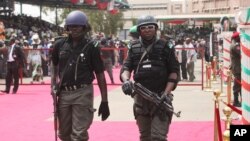
ABUJA — Nigeria's governors discussing a controversial plan to decentralize the country’s security forces by creating state police departments. Some officials say local police forces could increase security, but others fear the move will return the country to civil war.
Nigeria has not forgotten its civil war. In a brutal two-and-one-half years between 1967 and 1970 more than a million civilians and soldiers died from fighting and famine. Ethnic violence still plagues the country.
Today, the word “unity” can be seen everywhere in the capital: on street signs, billboards and on the lips of political leaders.
Former Inspector General of Police, Muhammadu Gambo, says decentralizing the security forces by creating state police departments could threaten this unity by giving local leaders militias.
He says before the civil war state police departments prevented politicians from conducting campaign activities in areas where their opponents were in control.
“There was a mass movement of troops and so on to ensure that nothing happened. If you want to disintegrate Nigeria then encourage this sort of thing. Nigeria will be gone,” said Gambo.
Gambo says most of Nigeria’s 36 states could not finance a police department if they had one.
But other prominent officials, including former president, General Ibrahim Babangida, say fears of civil war are outdated. They say local police departments are essential to strengthening democracy, citing the United States and the United Kingdom as countries that have both local and national security forces.
Nigeria’s security forces are battling militants in the north, kidnappings in the south and ethnic violence that has killed thousands in Nigeria’s “Middle Belt.”
Recent college graduate Paul-light Onah says, like many Nigerians, he wants more security and having state police departments and inspector generals could save lives.
“If it is not corrupt it will make less crime in Nigeria," he said. "It will make easy access and quick access to crime scenes. I believe if they have an IG [inspector general] in the state, at least it will be an easy patrol and they understand the state very well.”
Nigeria’s governors are meeting to debate the issue. The governors are now publicly divided, like much of Nigeria, between the north and the south.
Governors from the predominantly Muslim north oppose state police, while those from the mostly Christian south support the idea.
Nigeria has not forgotten its civil war. In a brutal two-and-one-half years between 1967 and 1970 more than a million civilians and soldiers died from fighting and famine. Ethnic violence still plagues the country.
Today, the word “unity” can be seen everywhere in the capital: on street signs, billboards and on the lips of political leaders.
Former Inspector General of Police, Muhammadu Gambo, says decentralizing the security forces by creating state police departments could threaten this unity by giving local leaders militias.
He says before the civil war state police departments prevented politicians from conducting campaign activities in areas where their opponents were in control.
“There was a mass movement of troops and so on to ensure that nothing happened. If you want to disintegrate Nigeria then encourage this sort of thing. Nigeria will be gone,” said Gambo.
Gambo says most of Nigeria’s 36 states could not finance a police department if they had one.
But other prominent officials, including former president, General Ibrahim Babangida, say fears of civil war are outdated. They say local police departments are essential to strengthening democracy, citing the United States and the United Kingdom as countries that have both local and national security forces.
Nigeria’s security forces are battling militants in the north, kidnappings in the south and ethnic violence that has killed thousands in Nigeria’s “Middle Belt.”
Recent college graduate Paul-light Onah says, like many Nigerians, he wants more security and having state police departments and inspector generals could save lives.
“If it is not corrupt it will make less crime in Nigeria," he said. "It will make easy access and quick access to crime scenes. I believe if they have an IG [inspector general] in the state, at least it will be an easy patrol and they understand the state very well.”
Nigeria’s governors are meeting to debate the issue. The governors are now publicly divided, like much of Nigeria, between the north and the south.
Governors from the predominantly Muslim north oppose state police, while those from the mostly Christian south support the idea.