



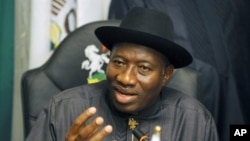
Delegates from Nigeria's ruling party are gathering in the capital for a convention to choose their presidential nominee. Politicians will decide the fate of regional power-sharing in Nigeria.
Nigeria's ruling party has won the last three presidential elections. So this nominee will clearly be the frontrunner in April's vote. But party delegates in Abuja are also deciding the future of an informal power-sharing deal that rotates the presidency between Nigeria's mainly Muslim north and its predominantly Christian south.
If delegates choose former vice president Atiku Abubakar, they will be sticking to an agreement that gives northern Nigerians another four years in office following the death of President Umaru Musa Yar'Adua.
If delegates choose current president Goodluck Jonathan, they will be breaking with that plan in favor of a southern leader who took office amidst the political uncertainty surrounding Mr. Yar'Adua's death.
Professor Sylvester Monye is the executive secretary of Nigeria's National Planning Commission. He says President Jonathan has clearly demonstrated his ability to revive the country's economy, moving so decisively that Monye says it is sometimes difficult for people to understand how much he has done so quickly.
"You wouldn't believe that, for the first time in about 12 years in Nigeria, we have had a Christmas and New Year come and gone without any single queue in any petrol station," said Monye. "For the first time in over ten years, we have all our refineries working. For the first time in 28 years, we now have a national medium-term plan which means that we are now planning and executing plans based on some framework unlike before, when we were doing things like we were groping in the dark."
This is expected to be a close contest between Mr. Jonathan and Mr. Abubakar. Mr. Jonathan has the advantage of incumbency. Mr. Abubakar has the advantage of standing as the consensus candidate of Nigeria's powerful northern political class.
University of Abuja political science professor Kabiru Mato says the strength of northern support for abiding by the regional power-sharing agreement may be just enough to tip the contest in Mr. Abubakar's favor.
"That’s one of the factors really that, in my view, will sway quite a lot of northern votes to vice president Atiku Abubakar because, truly, the question of rotation and zoning of political offices, especially the presidency, is an integral part of the PDP constitution," noted Mato. "So if that is the issue, then there is a great deal of sympathy that likely will benefit the former vice president, especially from the conservative voting force that will be delegates in the party primary."
The opposition Action Congress of Nigeria party has scheduled its primary to follow Thursday's People's Democratic Party contest. The Action party says the loser of the ruling-party primary is welcome to run for its nomination.