


News / Africa

Nigerian Senator-Elect Says Strongest Presidential Candidate Won

Magnus Ngei Abe of Rivers State says party of challenger Muhammadu Buhari lacked presence across the country

Multimedia

Audio
  • interview with Senator-elect Magnus Ngei Abe of Rivers State

TEXT SIZE - +

A senator-elect from Nigeria’s Rivers State says the strongest and most popular candidate won last week-end’s presidential polls, in which incumbent President Goodluck Jonathan of the Peoples Democratic Party [PDP] prevailed over his closest rival, General Muhammadu Buhari of the Congress for Progressive Change [CPC]. Buhari supporters rioted across parts of the north, saying the vote had been rigged.
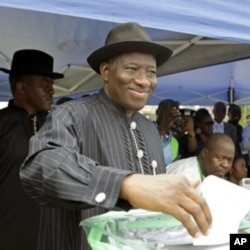
Nigerian President Goodluck Jonathan casts his ballot in his home village of Otuoke, Bayelsa state.

“As leaders, we should learn to tell our people the truth,” said Magnus Ngei Abe, a senator-elect for Rivers’ south-east senatorial district.  “All of us who are political leaders could see right from the early part of this campaign that [the strength of] the presidential candidate of the CPA, and the CPC itself…has not been established in every part of the country.’’

Triumph

Abe called President Jonathan’s win “a victory for democracy…for national unity and…for Africa.”

International observers say the poll was Nigeria’s most transparent since the country returned from military rule more than 10 years ago. Many credit the leadership of Attahiru Jega, the head of the Independent National Electoral Commission [INEC], which made several changes meant to improve efficiency and reduce mistrust.

“ We have proven in this country that we can actually do things in a manner that is acceptable and respectable,” he said, “and I think that all well-meaning and patriotic citizens …should be grateful to Professor Jega for the kind of credibility he was able to bring to this process,’’ said Abe.

Look ahead

The senator-elect says the challenges facing President Jonathan are well known – and include corruption, economic growth and delivery of social services.

‘’We need to establish discipline in our national life. We need to focus on our economy. To do that, brings you to same old questions of security, power, economics, the better distribution of available resources and available opportunities in such a way that every section of this country will feel a sense of belonging and also be able to make a contribution,’’ he said.

You May Like

Experts Weigh In on Challenges of Closing Guantanamo Prison

Former chief military prosecutor at Guantanamo delivers petition to White House with more than 370,000 signatures, demanding facility be closed down immediately More

Karzai to Discuss Enhancing Defense Ties with India

Afghanistan looking for more military aid as it prepares for withdrawal of NATO forces by next year More

India, China Pledge to Overcome Border Tensions

Indian prime minister and Chinese premier attempt to move past tense standoff in the Himalayas during Delhi talks More

Burmese President Opens US Visit with VOA Town Hall Meeting

Ahead of his meeting with President Obama Monday, Thein Sein answered questions on human rights and economic development in his country More

This forum has been closed.
Comments
     
There are no comments in this forum. Be first and add one

Featured Videos

Your JavaScript is turned off or you have an old version of Adobe's Flash Player. Get the latest Flash player.
Video

Video US Oil Surge Could Impact Mideast Geopolitics

The United States will account for a third of new oil supplies over the next five years, and will become energy self-sufficient in 20 years, according to a new report by the Paris-based International Energy Agency (IEA). Although U.S. oil imports from Arab Gulf countries increased last year, analysts predict the U.S. will lose its dependence on Middle East imports, which is expected to have a huge impact on international relations and the balance of power. VOA's Henry Ridgewell reports.