


Across Africa, plastic bags blemish rural and urban scenery, damage ground water and soils, and choke livestock and fish, entangle birds and threaten animals in general. They also block sewage pipes, turning them into safe havens for mosquitoes, which cause malaria.
They’re cheap and people don’t give a thought to throwing them away, but it takes a thousand years for them to decompose. When they do degrade, they break into small toxic particles that contaminate water and soils.
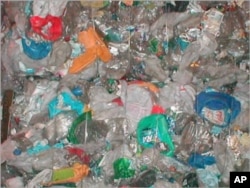
The UN Environment Program, UNEP, estimates that some four or five trillion plastic bags are manufactured worldwide every year, with only one percent being recycled.
Now Nigerian scientists are looking at ways to beat the scourge with biodegradable plastic bags.
The work is being done at the Biotechnology Advanced Laboratory in Abuja, a part of the government’s Sheda Science and Technology Complex.
Researchers are working to embed biodegradable starch in polymers, which are used to make plastics. Next, they identify microbes that would feed on the starch and cause it to break down completely into organic material, which would then be assimilated back into the soil.
Prof Godwin Ogbadu is director of the Abuja-based Biotechnology Advanced Laboratory.
"In this case, he says, "the microorganism we have isolated will use the polymer as its food and will dissolve it."
The Nigerian approach is not the only one. In South Africa, experts are developing plastic bags that dissolve into water and carbon dioxide in prolonged exposure to sunlight.
In Mali, experts are working using them to make paving stones.
Some governments are passing laws to ban or curb the use of plastic bags. Several economists argue that restrictions will lead to unemployment and revenue loss, while others say it will save millions of barrels of oil used in producing plastic bags.
They also say there may be economic gains.
Dr. Shola Odusanya is deputy director on the Biotechnology and Genetic Engineering Laboratory, part of the Sheda Science and Technology Complex. He and his colleagues are working to reduce the amount of plastic waste with a process that breaks it down into powder. The Nigerian scientist says,
"The process involves using some proprietary solvents we want to keep secret because this is a potentially very big commercial project. One of the uses of this is water-repellent paint. Actually, one of our colleagues has developed paint based on this material."
Odusanya says the project will become marketable and will create new jobs. Litter bins for plastic waste will be set up nationwide, and people will be recruited to search through the dumps for plastics.
In some countries, like Cameroon, waste management systems are inadequate and environmental laws rarely enforced. In those cases, the approach is different. An eco-friendly artist, Nereus Patrick Cheo, has recruited an army of street children. Together they rake through foul-smelling refuse dumps for plastics, which Cheo transforms into flower jars, beads, statues and murals.
For now, the bulging heaps of abandoned waste, especially plastics, remain. And so environmentalists are hoping Dr. Odusanya’s project will be successful and can be used by scientists in other parts of Africa.