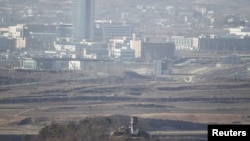
Rising tensions on the Korean peninsula are jeopardizing a joint industrial project that has served as one of the few remaining symbols of reconciliation between Seoul and Pyongyang.
North Korea has warned the South it will abandon the Kaesong Industrial Complex and turn the border area back into a military zone if Seoul follows through on its pledge to tighten inspections there.
Earlier this week, Seoul's Unification Ministry said it would more closely monitor industrial parts and other cargo shipped into the facility, as a result of expanded U.N. sanctions against Pyongyang following a banned November rocket launch.
North Korean has reacted angrily to the sanctions, promising to launch more missiles and conduct another nuclear test, which is expected to take place in just days.
A spokesperson for North Korea's National Economic Cooperation Committee says any change in Seoul's policy toward Kaesong, "even to the slightest degree or whatever form," will be viewed as a "vicious sanction."
The spokesperson, who was quoted in the official Korean Central News Agency, said North Korea would turn the factory back into a military zone, stressing it had given up a strategic border area to make room for the complex.
The Kaesong complex, which opened in 2004, is the last remaining economic link between the two Koreas, who remain in a technical state of war.
Despite increased tensions in recent years, the complex has continued to grow. It has become an important source of income for the impoverished North, employing more than 50,000 North Koreans.
More than 123 South Korean businesses operate in the 3.3-square kilometer complex, which produces clothes, utensils, watches and other items.
North Korea has warned the South it will abandon the Kaesong Industrial Complex and turn the border area back into a military zone if Seoul follows through on its pledge to tighten inspections there.
Earlier this week, Seoul's Unification Ministry said it would more closely monitor industrial parts and other cargo shipped into the facility, as a result of expanded U.N. sanctions against Pyongyang following a banned November rocket launch.
North Korean has reacted angrily to the sanctions, promising to launch more missiles and conduct another nuclear test, which is expected to take place in just days.
A spokesperson for North Korea's National Economic Cooperation Committee says any change in Seoul's policy toward Kaesong, "even to the slightest degree or whatever form," will be viewed as a "vicious sanction."
The spokesperson, who was quoted in the official Korean Central News Agency, said North Korea would turn the factory back into a military zone, stressing it had given up a strategic border area to make room for the complex.
The Kaesong complex, which opened in 2004, is the last remaining economic link between the two Koreas, who remain in a technical state of war.
Despite increased tensions in recent years, the complex has continued to grow. It has become an important source of income for the impoverished North, employing more than 50,000 North Koreans.
More than 123 South Korean businesses operate in the 3.3-square kilometer complex, which produces clothes, utensils, watches and other items.