


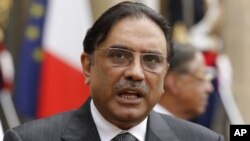
CHICAGO - Hopes for a meeting on the sidelines of the NATO summit bringing together the U.S., Afghan and Pakistani presidents appear to have dimmed, and analysts say this is due to the lack of a full agreement with Pakistan on reopening NATO supply lines into Afghanistan.
President Barack Obama met on Sunday in Chicago with Afghan President Hamid Karzai, but his schedule includes no one-on-one interaction with Pakistan’s President Asif Ali Zardari, and White House staff say the schedule is not expected to change.
Both U.S. and Pakistani officials were pushing for a trilateral meeting, with the main roadblock to such talks being the drawn-out dispute that has curtailed NATO's ability to supply coalition forces fighting in Afghanistan.
Pakistan shut down the transit corridors that NATO used for supply convoys last November, after U.S. airstrikes that mistakenly killed 24 Pakistani troops stationed near the Afghan border. The cross-border attack and its aftermath brought U.S.-Pakistan relations to a new low.
Pakistan’s prime minister indicated last week that progress had been made in negotiations with U.S. officials about reopening the supply routes, and he predicted an agreement would be complete “very soon.” NATO Secretary General Anders Fogh Rasmussen then called President Zardari to invite him to the Chicago summit.
Some South Asia experts suggest that while NATO's invitation to the president of Pakistan was unconditional, any interaction with the U.S. president might not have been so.
President Zardari did meet with President Karzai and with U.S. Secretary of State Hillary Clinton in Chicago, about Pakistan’s role in regional peace and the end stages of NATO's involvement in Afghanistan.
The meeting between Mr. Zardari and Clinton lasted for over an hour. Others present included Pakistani Foreign Minister Hina Rabbani Khar, Pakistan’s ambassador to the U.S., Sherry Rehman, the U.S. ambassador to Pakistan, Cameron Munter, and the U.S. government's special representative to Afghanistan and Pakistan, Marc Grossman.
Grossman told VOA the meeting included “a complete review of all of our bilateral partnerships.” He added that the purpose was to focus on “how to move forward in this relationship.”
The senior U.S. envoy said the talks on Sunday will help with the ongoing negotiations over the NATO supply routes, and he played down the significance of the Obama-Karzai-Zardari meeting that did not take place, saying it would be "better" for Afghanistan and Pakistan to hold direct bilateral talks.
Meanwhile, the meeting between Presidents Zardari and Karzai resulted in a decision to extend the Afghanistan-Pakistan Transit Trade Agreement to countries in Central Asia.