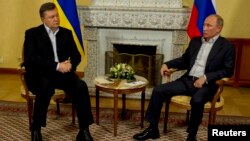
Russian President Vladimir Putin and Ukrainian leader Viktor Yanukovich ended talks on Monday without any sign of a breakthrough to end a standoff over the price of gas imports to Kyiv.
Ukraine, a transit route for more than half of Russian gas shipped to the European Union, wants to pay less for gas from Russia because it says a 2009 deal set an exorbitant price.
Moscow has sought concessions in return, such as Ukraine joining a post-Soviet trade bloc led by Moscow and giving up control of its pipeline network.
The two presidents' negotiations outside Moscow ended without any statement, and Putin's spokesman declined to say whether talks would continue.
The dispute between the two former Soviet republics is watched closely in Europe, which receives a quarter of its gas from Russia and as energy supply troubles have underscored Europe's vulnerability to imports recently.
On Monday, Putin and Yanukovich met in Zavidovo, some 120 kilometers (75 miles) north of Moscow, a favored hunting spot of former Soviet leader Leonid Brezhnev.
Putin, who has called the Soviet Union's collapse "the biggest geopolitical catastrophe of the century", suggested Moscow's economic cooperation with Kyiv could be in jeopardy if it refused to join the customs union, which links Kazakhstan, Russia and Belarus.
"The closer we work with Kazakhstan and Belarus, the harder it is for Ukraine to enter our markets," Putin said at the start of the meeting with Yanukovich.
But Yanukovich has refused to bend to Russia's calls for its participation in the union and Kiev has sought to balance ties between Moscow and the EU, which doesn't approve of its possible entrance into the trade bloc.
In 2011, Russia struck a deal with customs union-member Belarus that sold 1,000 cubic metres of gas at $165.60 - compared to the $430 Russia charges Ukraine and the $366 it expects to sell in Europe on average this year.
Yanukovich has called the expensive gas it imports from Russia "the noose around our neck".
"The development of economic integration and Ukraine's cooperation with the Customs Union have to be discussed," he said to Putin on Monday.
Ukraine, a transit route for more than half of Russian gas shipped to the European Union, wants to pay less for gas from Russia because it says a 2009 deal set an exorbitant price.
Moscow has sought concessions in return, such as Ukraine joining a post-Soviet trade bloc led by Moscow and giving up control of its pipeline network.
The two presidents' negotiations outside Moscow ended without any statement, and Putin's spokesman declined to say whether talks would continue.
The dispute between the two former Soviet republics is watched closely in Europe, which receives a quarter of its gas from Russia and as energy supply troubles have underscored Europe's vulnerability to imports recently.
On Monday, Putin and Yanukovich met in Zavidovo, some 120 kilometers (75 miles) north of Moscow, a favored hunting spot of former Soviet leader Leonid Brezhnev.
Putin, who has called the Soviet Union's collapse "the biggest geopolitical catastrophe of the century", suggested Moscow's economic cooperation with Kyiv could be in jeopardy if it refused to join the customs union, which links Kazakhstan, Russia and Belarus.
"The closer we work with Kazakhstan and Belarus, the harder it is for Ukraine to enter our markets," Putin said at the start of the meeting with Yanukovich.
But Yanukovich has refused to bend to Russia's calls for its participation in the union and Kiev has sought to balance ties between Moscow and the EU, which doesn't approve of its possible entrance into the trade bloc.
In 2011, Russia struck a deal with customs union-member Belarus that sold 1,000 cubic metres of gas at $165.60 - compared to the $430 Russia charges Ukraine and the $366 it expects to sell in Europe on average this year.
Yanukovich has called the expensive gas it imports from Russia "the noose around our neck".
"The development of economic integration and Ukraine's cooperation with the Customs Union have to be discussed," he said to Putin on Monday.