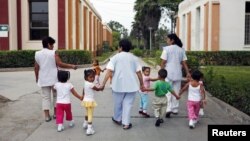
Some 210 million youngsters around the world, according to UNICEF, are orphaned or live on the streets, forced into a precarious life by war, poverty or illness. Among the organizations working to help them is one prompted by a chance meeting on a New Delhi street. Help for Orphans focuses on teaching street children the skills they need for a better future.
In 2004, Sarah Ehrlich was on a trip to India with her husband, an art dealer. One day, as she waited in their car while he bought artwork at a store, a small boy approached her.
“He was about 8-years-old and he was holding a baby," said Ehrlich. "This baby couldn’t have been more than a week old. He was standing next to the car, by my window. He kept pushing the baby, head forward and saying, ‘feed the baby, feed the baby’. Every time he would come forward, the baby’s head would hit the back window of the car.”
That moment changed her life. She said, "I just wanted to make it my life work at that point to help street children, orphan children. I couldn’t see children living like that.”
She began by donating money to charities working with orphans in India. A year later, in 2005, she founded Help for Orphans. The non-profit group takes a comprehensive approach to helping street children.
“It teaches these kids job skills, getting them on their feet and making them these citizens that actually give back to their community,” she said.
Help For Orphans now works with organizations in Latin America, Asia and Africa. In Kisii, Kenya, it helped build a school. Forty-five orphans are among its 150 students.
“We are getting them the knowledge - primary school through secondary school. After that we’re helping those kids to go to universities,” said Peter Mageri, the principal of the Kisii School.
Mageri said the curriculum includes vocational training like "farming, small scale farming, growing some local food. He said, "We also teach them carpentry, how to build houses and train [them] on computers.”
Sarah Ehrlich said the job-training programs vary from one country to another. “For instance, we had a survey done in Honduras. And the skills that we knew that the children would get a job, those skills were being an electrician or an auto mechanic for boys, and for women they are seamstress or nurse,” she said.
In Haiti, for instance, Help for Orphans is focusing on poultry farming in partnership with SOS Children’s Villages International. Its spokesman in Port au Prince, Laguerre Reynald, expects about 40 children to participate in the training when it begins in September.
“They are going to learn how to feed the chicken, take care of [the chicken]. Also the eggs, they’re going to learn how to cook and take care of themselves,” said Reynald.
Sarah Ehrlich is excited about the project. She said, it basically sets up "an 8,000 chicken coop that throws up to 7500 eggs a day. So it creates a lot of jobs.”
The program could become a model for other places, she said, helping more orphans and their communities.
In 2004, Sarah Ehrlich was on a trip to India with her husband, an art dealer. One day, as she waited in their car while he bought artwork at a store, a small boy approached her.
“He was about 8-years-old and he was holding a baby," said Ehrlich. "This baby couldn’t have been more than a week old. He was standing next to the car, by my window. He kept pushing the baby, head forward and saying, ‘feed the baby, feed the baby’. Every time he would come forward, the baby’s head would hit the back window of the car.”
That moment changed her life. She said, "I just wanted to make it my life work at that point to help street children, orphan children. I couldn’t see children living like that.”
She began by donating money to charities working with orphans in India. A year later, in 2005, she founded Help for Orphans. The non-profit group takes a comprehensive approach to helping street children.
“It teaches these kids job skills, getting them on their feet and making them these citizens that actually give back to their community,” she said.
Help For Orphans now works with organizations in Latin America, Asia and Africa. In Kisii, Kenya, it helped build a school. Forty-five orphans are among its 150 students.
“We are getting them the knowledge - primary school through secondary school. After that we’re helping those kids to go to universities,” said Peter Mageri, the principal of the Kisii School.
Mageri said the curriculum includes vocational training like "farming, small scale farming, growing some local food. He said, "We also teach them carpentry, how to build houses and train [them] on computers.”
Sarah Ehrlich said the job-training programs vary from one country to another. “For instance, we had a survey done in Honduras. And the skills that we knew that the children would get a job, those skills were being an electrician or an auto mechanic for boys, and for women they are seamstress or nurse,” she said.
In Haiti, for instance, Help for Orphans is focusing on poultry farming in partnership with SOS Children’s Villages International. Its spokesman in Port au Prince, Laguerre Reynald, expects about 40 children to participate in the training when it begins in September.
“They are going to learn how to feed the chicken, take care of [the chicken]. Also the eggs, they’re going to learn how to cook and take care of themselves,” said Reynald.
Sarah Ehrlich is excited about the project. She said, it basically sets up "an 8,000 chicken coop that throws up to 7500 eggs a day. So it creates a lot of jobs.”
The program could become a model for other places, she said, helping more orphans and their communities.