


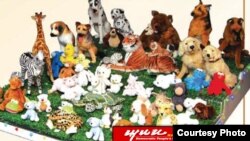
The U.S. non-profit group that produces the children's television show Sesame Street says a major North Korean toy maker is producing unlicensed replicas of popular characters from the internationally syndicated educational program.
North Korea's Kyonghung Trading Corporation has been advertising the toys for sale to the international market, using an advertisement published in a North Korean government "Foreign Trade" magazine. Three of the stuffed animals pictured in the ad resemble Sesame Street's Big Bird, Cookie Monster and Elmo.
In a statement emailed to VOA Wednesday, Sesame Workshop said "we believe the toys pictured are unauthorized." The multi-media company sells its own plush toys featuring the characters and uses licensees such as New Jersey-based toy maker GUND to produce them in China, Bangladesh and elsewhere.
Dozens of toys
Kyonghung says its Pyongyang toy factory was established in 2005 and has an annual output of hundreds of thousands of items, including more than 60 types of toy. It says it employs a "large number of toy experts and skilled workers with elaborate craftsmanship."
Sesame said it has not faced a major copyright infringement case outside the United States in the last few years. The non-profit group said it takes "appropriate legal actions" in response to infringements when it believes they can be "effective."
Sesame may find it difficult to sue Kyonghung because the United States and North Korea do not have diplomatic relations and have remained in a technical state of war since the end of the Korean War in 1953.
In a separate statement to VOA, GUND spokeswoman Doris Bernar said the Kyonghung products "appear to be confusingly similar to copyrighted products of Sesame or GUND, but it is unclear from the advertisement." She said GUND has "successfully protected (its) rights internationally on numerous occasions."
Disney complaint
U.S. media giant Walt Disney Company made a similar complaint about North Korea last July, when North Korean state television broadcast images of an unprecedented concert with performers dressed as Disney characters such as Minnie Mouse and Tigger.
The concert by a North Korean band was held in honor of the nation's young new leader, Kim Jong Un, who appears to have eased restrictions on Western culture in the reclusive state. The Walt Disney Company said it had "not licensed or authorized" the performance, but did not disclose whether any action would be taken.
Sesame also told VOA its licensees in China and other countries have not outsourced the manufacturing of any products to North Korea.
Outsourcing concern
In an article published Tuesday, North Korean news blog NK News said it has become "increasingly common" for Chinese manufacturers to "outsource" production to North Korea, where labor costs tend to be lower.
U.S. sanctions forbid imports to the United States of North Korean goods and services, including those that are used as components of products finished in a third country.
Sesame said it "periodically" visits the Asian factories of its licensees to ensure that they comply with "stringent manufacturing obligations." GUND, one of those licensees, said it has long-term relationships with its factories and requires them to sign written agreements that prohibit outsourcing or subcontracting without its consent.
The U.S. Treasury Department said violators of the North Korean import ban face fines of up to $1 million and a maximum sentence of 20 years in prison. When asked by VOA about the Kyonghung toy case, a Treasury official said the department does not comment on "specific potential violations" of the sanctions program.