


SEOUL —
South Korea is asserting, based on debris it recovered from North Korea's rocket launch this month, that the reclusive state has significantly advanced its ballistic missile technology.
As the U.N. Security Council prepares to decide on further sanctions against Pyongyang, military officials in Seoul are releasing details about the technology used in North Korea's December 12th launch in defiance of existing U.N. sanctions.
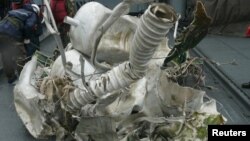
The Ministry of National Defense says it has retrieved several pieces of the rocket's first stage in the Yellow Sea. Its officials say initial analysis leaves little doubt North Korea conducted a test of intercontinental ballistic missile (ICBM) technology.
A Defense Ministry official, who would not release his name, says an analysis of the material from the Unha-3 rocket shows it has "a range of more than 10,000 kilometers if it were to carry a warhead of 500 to 600 kilograms."
Big technology improvements
Until now, many observers of North Korea's missile development believed it had technology to only carry into space an object weighing up to 100 kilograms.
The improved parameters give North Korea the capability of hitting Los Angeles on the U.S. West coast. But analysts here and in other countries strongly doubt North Korea has miniaturized a nuclear weapon that could be placed atop a missile and survive a re-entry through the atmosphere.
Officials say experts examining a three-ton oxidizer container, recovered after the launch, concluded the first-stage contained highly toxic red fuming nitric acid to help support the combustion of the rocket's fuel.
This oxidizer, known as AK-27, is also used by Iran in its Scud missiles and can be stored ready to launch for a long time at normal temperatures.
South Korean officials claim this indicates Pyongyang intends to develop ICBMs.
Pyongyang has company
Iran and North Korea are known to have conducted joint testing in the early 1990s and subsequently have shared such technology for their missile and nuclear programs. There are unconfirmed reports Iranian rocket engineers were on site for North Korea's failed April 13th launch and again for the one this month.
The red fuming nitric acid oxidizer was used by the Soviet Union for its Cold War ballistic missiles, and also, until recent years, by successor Russia to help launch heavier payloads, such as multiple satellites, into orbit.
South Korean officials say they are also trying to determine whether North Korea imported the corrosive aluminum alloy used to build the rocket. They say the eight panels from the first stage that were retrieved were crudely welded manually.
Other components, the officials say, such as compression sensors and electric wires, were found to have been imported.
The comments by Defense Ministry officials in Seoul were made Friday but embargoed for release until Sunday.
Kim applauds success
North Korea hailed its latest launch as a success and said it deployed a peaceful Earth observation satellite into orbit.
North Korean leader Kim Jong Un on Friday praised his country's rocket scientists and technicians at a Pyongyang banquet.
Kim says the launch was North Korea's "legal right in the peaceful use of space and a historical achievement of our [Songun] military-first policy showing our overall national power."
He also called on the scientists to develop more powerful rockets and additional communications satellites.
No transmissions from the satellite, however, have been detected to demonstrate that it is operational.
Pyongyang's one-upsmanship
But the successful firing of a three-stage rocket - after previous failed attempts, and placing an object into orbit - is a significant propaganda victory for Pyongyang over Seoul.
South Korea has tried and failed three times to launch from its soil its own satellites into space.
South Korea's is the world's 15th largest economy. North Korea, by contrast, is one of the world's poorest.
The two Koreas have no diplomatic relations. They have remained in a state of war since 1953 when three years of devastating combat ended in stalemate.
As the U.N. Security Council prepares to decide on further sanctions against Pyongyang, military officials in Seoul are releasing details about the technology used in North Korea's December 12th launch in defiance of existing U.N. sanctions.
The Ministry of National Defense says it has retrieved several pieces of the rocket's first stage in the Yellow Sea. Its officials say initial analysis leaves little doubt North Korea conducted a test of intercontinental ballistic missile (ICBM) technology.
A Defense Ministry official, who would not release his name, says an analysis of the material from the Unha-3 rocket shows it has "a range of more than 10,000 kilometers if it were to carry a warhead of 500 to 600 kilograms."
Big technology improvements
Until now, many observers of North Korea's missile development believed it had technology to only carry into space an object weighing up to 100 kilograms.
The improved parameters give North Korea the capability of hitting Los Angeles on the U.S. West coast. But analysts here and in other countries strongly doubt North Korea has miniaturized a nuclear weapon that could be placed atop a missile and survive a re-entry through the atmosphere.
Officials say experts examining a three-ton oxidizer container, recovered after the launch, concluded the first-stage contained highly toxic red fuming nitric acid to help support the combustion of the rocket's fuel.
This oxidizer, known as AK-27, is also used by Iran in its Scud missiles and can be stored ready to launch for a long time at normal temperatures.
South Korean officials claim this indicates Pyongyang intends to develop ICBMs.
Pyongyang has company
Iran and North Korea are known to have conducted joint testing in the early 1990s and subsequently have shared such technology for their missile and nuclear programs. There are unconfirmed reports Iranian rocket engineers were on site for North Korea's failed April 13th launch and again for the one this month.
The red fuming nitric acid oxidizer was used by the Soviet Union for its Cold War ballistic missiles, and also, until recent years, by successor Russia to help launch heavier payloads, such as multiple satellites, into orbit.
South Korean officials say they are also trying to determine whether North Korea imported the corrosive aluminum alloy used to build the rocket. They say the eight panels from the first stage that were retrieved were crudely welded manually.
Other components, the officials say, such as compression sensors and electric wires, were found to have been imported.
The comments by Defense Ministry officials in Seoul were made Friday but embargoed for release until Sunday.
Kim applauds success
North Korea hailed its latest launch as a success and said it deployed a peaceful Earth observation satellite into orbit.
North Korean leader Kim Jong Un on Friday praised his country's rocket scientists and technicians at a Pyongyang banquet.
Kim says the launch was North Korea's "legal right in the peaceful use of space and a historical achievement of our [Songun] military-first policy showing our overall national power."
He also called on the scientists to develop more powerful rockets and additional communications satellites.
No transmissions from the satellite, however, have been detected to demonstrate that it is operational.
Pyongyang's one-upsmanship
But the successful firing of a three-stage rocket - after previous failed attempts, and placing an object into orbit - is a significant propaganda victory for Pyongyang over Seoul.
South Korea has tried and failed three times to launch from its soil its own satellites into space.
South Korea's is the world's 15th largest economy. North Korea, by contrast, is one of the world's poorest.
The two Koreas have no diplomatic relations. They have remained in a state of war since 1953 when three years of devastating combat ended in stalemate.