


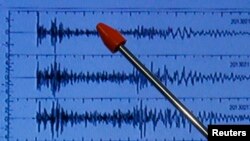
North Korea, one of Asia’s poorest nations, has spent hundreds of millions of dollars in developing nuclear weapons. Yet that ambition has resulted in ever-tightening economic and diplomatic sanctions that make its poverty and isolation worse.
As the world assesses Pyongyang's third nuclear weapons test, many policymakers ask why North Korea persists with its nuclear ambitions.
North Asia security experts say one key reason is that Pyongyang sees nuclear weapons as a tool to get international attention and to force bigger, wealthier nations - chiefly the United States, to negotiate with it.
Bruce Klingner, a Northeast Asia expert at the Heritage Foundation research institute, says that North Korea often alternates between trying to charm and then trying to intimidate the international community to get what it wants.
Very often, he says, even when it tries to charm, Pyongyang provokes, and it finds provocation useful.
“In a way, it makes them relevant," Klingner saidTuesday. "If they didn’t have nuclear weapons, if they didn’t have a large conventional army, if they didn’t saber rattle, then we could ignore them.”
The Korean Peninsula was divided after World War II into a communist-ruled North and a U.S.-backed South. From 1950 to 1953, the two fought a bitter war that ended in a draw; they signed an armistice but never a peace treaty. North and South Korea remain technically at war.
Over the decades, South Korea has evolved into a thriving democracy that is one of the wealthiest nations in the world. It is firmly allied with the United States, which bases about 28,000 American troops in the country, as a deterrence to the North.
The North has been increasingly isolated since the end of the Cold War between the former Soviet Union and Western nations. As its former allies turned to open markets and democracy, Pyongyang lost trade and income. For two decades, its main source of trade and aid has been neighboring China.
The government remains firmly in the hands of the ruling Workers Party, and its current leader, Kim Jong Un, followed his grandfather and father to rule North Korea.
But the economy has declined steadily over the past 30 years, and North Korea suffered a famine in the mid-1990s. Even now, it relies on foreign aid to feed its people.
The country’s leaders emphasize its military over its economy. Regional analysts say this is partly because of fears of its stronger neighbor and the United States.
Raymond Tanter, an expert on weapons proliferation at Georgetown University, also says Pyongyang uses its military focus to maintain legitimacy at home.
“The North Korean leadership has traditionally chosen guns over butter, that is to say the military option over feeding the people. And I think that this test is to galvanize the people around Kim Jong Un as a great leader in the tradition of his grandfather and his father,” Tanter says.
Maintaining the Kim dynasty, several analysts have said, is so important to Pyongyang that it is willing to defy United Nations sanctions against it, and even rebel against the guidance of its ally, China. Joining the international community just is not important to North Korea, they say.
As the world assesses Pyongyang's third nuclear weapons test, many policymakers ask why North Korea persists with its nuclear ambitions.
North Asia security experts say one key reason is that Pyongyang sees nuclear weapons as a tool to get international attention and to force bigger, wealthier nations - chiefly the United States, to negotiate with it.
Bruce Klingner, a Northeast Asia expert at the Heritage Foundation research institute, says that North Korea often alternates between trying to charm and then trying to intimidate the international community to get what it wants.
Very often, he says, even when it tries to charm, Pyongyang provokes, and it finds provocation useful.
“In a way, it makes them relevant," Klingner saidTuesday. "If they didn’t have nuclear weapons, if they didn’t have a large conventional army, if they didn’t saber rattle, then we could ignore them.”
The Korean Peninsula was divided after World War II into a communist-ruled North and a U.S.-backed South. From 1950 to 1953, the two fought a bitter war that ended in a draw; they signed an armistice but never a peace treaty. North and South Korea remain technically at war.
Over the decades, South Korea has evolved into a thriving democracy that is one of the wealthiest nations in the world. It is firmly allied with the United States, which bases about 28,000 American troops in the country, as a deterrence to the North.
The North has been increasingly isolated since the end of the Cold War between the former Soviet Union and Western nations. As its former allies turned to open markets and democracy, Pyongyang lost trade and income. For two decades, its main source of trade and aid has been neighboring China.
The government remains firmly in the hands of the ruling Workers Party, and its current leader, Kim Jong Un, followed his grandfather and father to rule North Korea.
But the economy has declined steadily over the past 30 years, and North Korea suffered a famine in the mid-1990s. Even now, it relies on foreign aid to feed its people.
The country’s leaders emphasize its military over its economy. Regional analysts say this is partly because of fears of its stronger neighbor and the United States.
Raymond Tanter, an expert on weapons proliferation at Georgetown University, also says Pyongyang uses its military focus to maintain legitimacy at home.
“The North Korean leadership has traditionally chosen guns over butter, that is to say the military option over feeding the people. And I think that this test is to galvanize the people around Kim Jong Un as a great leader in the tradition of his grandfather and his father,” Tanter says.
Maintaining the Kim dynasty, several analysts have said, is so important to Pyongyang that it is willing to defy United Nations sanctions against it, and even rebel against the guidance of its ally, China. Joining the international community just is not important to North Korea, they say.