


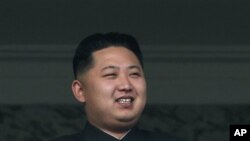
North Korea has revised the charter of its only political party, apparently to ensure a smooth transition of power from father to son in the reclusive communist state.
VOA correspondent Steve Herman has obtained a copy of the document, which has not been made public in or outside North Korea.
North Korea experts say the revised Korea Workers Party charter (PDF), obtained by VOA, appears to create the framework for ruler Kim Jong Il to be succeeded by his son, Kim Jong Un.
North Korea Workers Party Charter
The charter revision is dated September 28th last year, which was when party representatives met in Pyongyang. The following day the state-run news agency announced the charter had been revised to strengthen the party’s leadership and enhance its role in the army.
But specifics were not revealed, nor has the new charter been publicly issued.
Specialists on North Korea, including some in the intelligence community, who have seen the copy of the revised charter, say they have no reason to doubt its authenticity.
Government officials and academic analysts in Seoul say one of the changes to the charter allows the head of the party to also run the Central Military Commission, ensuring that one person is able to control all military and state affairs. Kim Jong Un, who is in his
late 20’s, co-chairs the commission along with 68-year-old Army Chief of Staff, Vice Marshall Ri Yong Ho.
Cheong Seong-chang is a senior fellow at the Sejong Institute, which studies South Korean defense and foreign affairs policy. He says the change means Kim Jong Un will have full authority to control the military and the country should his father suddenly die.
Cheong recalls the late communist Chinese leader Mao Zedong saying political power grows out of the barrel of a gun. Likewise in North Korea’s socialist system, control of the military is decisive. With the revision of the party charter, Cheong says, in effect a political decision has been made giving Kim Jong Un rule over the military.
North Korea follows what it calls a “military first” policy, which gives the country’s armed forces a dominant role in society, and means that whoever controls the army, can control the nation.
Pyongyang maintains one of the largest standing armies in the world – with more than one million in uniform. It also is developing nuclear weapons, despite past pledges that it would not.
A former U.S. State Department adviser on North Korea, Professor Balbina Hwang at the National Defense University in Washington, says something else can be inferred from the charter revision.
"This is a government that has institutions and rules, even though it is ruled by an omnipotent authority. But in fact there is such a thing as domestic politics within the society. It is not monolithic. There are different interest groups. And even the patina or facade of rules and laws actually matter," said Balbina Hwang.
Kim Jong Il’s youngest son, a virtually unknown figure in North Korea until last year, suddenly emerged into the spotlight when he was appointed a four-star general. Since then state media have frequently shown Kim Jong Un at prominent events alongside his father.
Most North Koreans have yet to learn about the changes to the party’s charter. State media, monitored outside the country, have not reported specifics nor released the new charter.
North Korea experts say that is another sign that the elder Kim is proceeding cautiously because of skepticism, domestically and internationally, about transferring power to a third generation of the family. Kim Jong Il succeeded his father, Kim Il Sung, who was North
Korea’s first leader.
North Korea is one of the world’s poorest countries. It has remained technically at war with prosperous South Korea since a 1953 truce halted fighting in their civil war.