


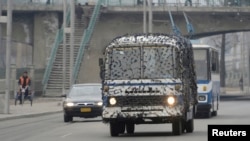
North Korea appears to be preparing its people for a potential conflict with the U.S.-backed South, by taking steps to camouflage public transport and broadcasting messages from citizens in favor of war.
South Korean and Japanese media reported Wednesday that authorities in Pyongyang have begun to cover up buses and trains with camouflage netting, a precautionary measure that has not been seen in the North Korean capital for years. South Korea's Yonhap news agency said the situation in Pyongyang was similar to 1993 when it declared a quasi state of war shortly before withdrawing from the Nuclear Non-proliferation Treaty.
North Korean state television also broadcast footage of Pyongyang residents, such as this man, expressing support for the government's threat to scrap a 1953 armistice with the United States in the coming days.
"North Korea cannot stand it any more," he said. "As long as the U.S. and South Korean puppets want war, I think we should form a strong army to take hold of this opportunity to reunify the Korean peninsula."
South Korean media said Pyongyang also has started submarine training as part of a program of military exercises.
South Korean General Kim Yong-hyun reacted to the latest North Korean moves by vowing a "strong and decisive" response if Pyongyang follows through on Tuesday's threat to break the truce.
"If North Korea dares to undertake provocation and to threaten the lives and safety of our people, we make it clear that we have all preparations in place for a strong and decisive punishment, not only against the source of the aggression and its support forces, but also the commanding element," said General Yong-hyun.
North Korea said it plans to void the 1953 cease-fire that ended the Korean War because of a U.S.-led drive for sanctions against it and ongoing military exercises between Seoul and Washington.
It is not unusual for Pyongyang to issue such statements during times of heightened tension on the Korean peninsula. But, analysts said the latest threats may be more serious, because they were made by a high-ranking official, and came with a deadline.
In a Tuesday appearance on state television, North Korean General Kim Yong Chol said Pyongyang will "completely nullify" the armistice beginning March 11, and cut off communications to U.S. and South Korean forces at the border village of Panmunjom.
The deadline coincides with the start of a second round of U.S.-South Korea military exercises. A first round began earlier this month. The U.S. has said the annual drills are defensive in nature, but North Korea views them as preparation to invade.
Meanwhile, United Nations diplomats said they hope to vote Thursday on a resolution punishing North Korea for its latest nuclear test last month. The Security Council held a closed-door meeting on the issue Tuesday.
U.S. Ambassador Susan Rice said the resolution would impose some of the toughest sanctions ever ordered by the United Nations. She said the sanctions would target illicit activities by the North's diplomats and Pyongyang's banking relationships. It also would tighten inspections on cargo headed to and from the country.
The resolution, which has the support of both the U.S. and China, may further anger an already isolated North Korea. But despite its latest threats, many analysts said Pyongyang is unlikely to carry out large-scale clashes in response to the sanctions.
Mike Chinoy, an Asia analyst at the University of Southern California, told VOA the real danger lies in the possibility of an accidental clash next week, when North Korea is due to stage competing military drills at the same time as the United States and South Korea.
"All it would take is one helicopter that has a mechanical problem and has to come down on the North Korean side of the demilitarized zone, or some firing exercises in which somebody puts in the wrong coordinates and an artillery shell goes in the other direction," said Chinoy. "These kinds of accidents, which have happened before, could in the current circumstances create a dynamic of escalation that would be harder to manage."
The waters outside North and South Korea have been the scene of several deadly incidents in the past decade. The South blames the North for a 2010 torpedo attack on one of its coastal naval vessels that killed 46 personnel. Later that year, North Korea shelled a frontier island where the South has a military base. That attack killed four people, including two civilians.
South Korean and Japanese media reported Wednesday that authorities in Pyongyang have begun to cover up buses and trains with camouflage netting, a precautionary measure that has not been seen in the North Korean capital for years. South Korea's Yonhap news agency said the situation in Pyongyang was similar to 1993 when it declared a quasi state of war shortly before withdrawing from the Nuclear Non-proliferation Treaty.
North Korean state television also broadcast footage of Pyongyang residents, such as this man, expressing support for the government's threat to scrap a 1953 armistice with the United States in the coming days.
"North Korea cannot stand it any more," he said. "As long as the U.S. and South Korean puppets want war, I think we should form a strong army to take hold of this opportunity to reunify the Korean peninsula."
South Korean media said Pyongyang also has started submarine training as part of a program of military exercises.
South Korean General Kim Yong-hyun reacted to the latest North Korean moves by vowing a "strong and decisive" response if Pyongyang follows through on Tuesday's threat to break the truce.
"If North Korea dares to undertake provocation and to threaten the lives and safety of our people, we make it clear that we have all preparations in place for a strong and decisive punishment, not only against the source of the aggression and its support forces, but also the commanding element," said General Yong-hyun.
North Korea said it plans to void the 1953 cease-fire that ended the Korean War because of a U.S.-led drive for sanctions against it and ongoing military exercises between Seoul and Washington.
It is not unusual for Pyongyang to issue such statements during times of heightened tension on the Korean peninsula. But, analysts said the latest threats may be more serious, because they were made by a high-ranking official, and came with a deadline.
In a Tuesday appearance on state television, North Korean General Kim Yong Chol said Pyongyang will "completely nullify" the armistice beginning March 11, and cut off communications to U.S. and South Korean forces at the border village of Panmunjom.
The deadline coincides with the start of a second round of U.S.-South Korea military exercises. A first round began earlier this month. The U.S. has said the annual drills are defensive in nature, but North Korea views them as preparation to invade.
Meanwhile, United Nations diplomats said they hope to vote Thursday on a resolution punishing North Korea for its latest nuclear test last month. The Security Council held a closed-door meeting on the issue Tuesday.
U.S. Ambassador Susan Rice said the resolution would impose some of the toughest sanctions ever ordered by the United Nations. She said the sanctions would target illicit activities by the North's diplomats and Pyongyang's banking relationships. It also would tighten inspections on cargo headed to and from the country.
The resolution, which has the support of both the U.S. and China, may further anger an already isolated North Korea. But despite its latest threats, many analysts said Pyongyang is unlikely to carry out large-scale clashes in response to the sanctions.
Mike Chinoy, an Asia analyst at the University of Southern California, told VOA the real danger lies in the possibility of an accidental clash next week, when North Korea is due to stage competing military drills at the same time as the United States and South Korea.
"All it would take is one helicopter that has a mechanical problem and has to come down on the North Korean side of the demilitarized zone, or some firing exercises in which somebody puts in the wrong coordinates and an artillery shell goes in the other direction," said Chinoy. "These kinds of accidents, which have happened before, could in the current circumstances create a dynamic of escalation that would be harder to manage."
The waters outside North and South Korea have been the scene of several deadly incidents in the past decade. The South blames the North for a 2010 torpedo attack on one of its coastal naval vessels that killed 46 personnel. Later that year, North Korea shelled a frontier island where the South has a military base. That attack killed four people, including two civilians.