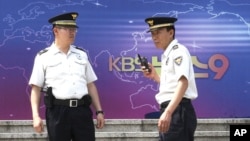
SEOUL - South Korea's government is chiding the North for a specific threat made by its military against some of the media in Seoul.
North Korea's military Monday threatened South Korea's major conservative media outlets, saying its soldiers had entered the latitude and longitude coordinates of their Seoul headquarters for possible attack.
South Korean reports say it is unprecedented for North Korea to publicly speak of map coordinates for specific targets.
This came in an “open ultimatum” by the general command staff of the (North) Korean People's Army.
The message read by an announcer on Pyongyang radio and attributed to the North Korean army general staff, targets South Korean media for critical reports about recent children's festivals hailing new leader Kim Jong Un.
The broadcast says the military has already targeted for punishment specific South Korean media outlets which it names. The announcer says such “fools, idiots and blockheads” will face retribution for criticizing the celebrations in the North.
One television channel in Seoul had compared the ceremonies to those of the Hitler Youth of Nazi-era Germany.
South Korea's Unification Ministry spokesman Kim Hyung-suk says it takes the threat seriously and calls North Korea's reaction way out of line.
Kim says the new military threat from Pyongyang is a significant challenge and provocation to freedom and democracy.
However, Yim Tae-hee - a former chief of staff to the current South Korean president, Lee Myung-bak - says Seoul should not over-react.
Speaking to correspondents, Yim - a declared presidential candidate of the ruling New Frontier Party - pleads for all to step back and put things in perspective. He says literally interpreting such threats could cause an erroneous move by Seoul in regards to relations with the North.
The two Koreas have no diplomatic ties. They have lived side-by-side for decades under an uneasy truce since their devastating three-year civil war in the early 1950's.
The South Korean capital, Seoul, with more than ten million people, is in the range of North Korean artillery.
Professor Ryu Gil-jae at the University of North Korean Studies in Seoul says a “cyber” attack against the South Korean media is more probable than a military action.
Ryu says a competition is underway in North Korea among various entities to demonstrate their loyalty to Kim Jong Un and such belligerent rhetoric directed at the South is one part of this.
Two provocations blamed on the North in 2010 - the sinking of a South Korean military ship and the shelling of a small island - killed 50 South Koreans, mainly military personnel. The South Korean government has warned there will be retaliation by its forces if there are any additional attacks by the North.
North Korea's military Monday threatened South Korea's major conservative media outlets, saying its soldiers had entered the latitude and longitude coordinates of their Seoul headquarters for possible attack.
South Korean reports say it is unprecedented for North Korea to publicly speak of map coordinates for specific targets.
This came in an “open ultimatum” by the general command staff of the (North) Korean People's Army.
The message read by an announcer on Pyongyang radio and attributed to the North Korean army general staff, targets South Korean media for critical reports about recent children's festivals hailing new leader Kim Jong Un.
The broadcast says the military has already targeted for punishment specific South Korean media outlets which it names. The announcer says such “fools, idiots and blockheads” will face retribution for criticizing the celebrations in the North.
One television channel in Seoul had compared the ceremonies to those of the Hitler Youth of Nazi-era Germany.
South Korea's Unification Ministry spokesman Kim Hyung-suk says it takes the threat seriously and calls North Korea's reaction way out of line.
Kim says the new military threat from Pyongyang is a significant challenge and provocation to freedom and democracy.
However, Yim Tae-hee - a former chief of staff to the current South Korean president, Lee Myung-bak - says Seoul should not over-react.
Speaking to correspondents, Yim - a declared presidential candidate of the ruling New Frontier Party - pleads for all to step back and put things in perspective. He says literally interpreting such threats could cause an erroneous move by Seoul in regards to relations with the North.
The two Koreas have no diplomatic ties. They have lived side-by-side for decades under an uneasy truce since their devastating three-year civil war in the early 1950's.
The South Korean capital, Seoul, with more than ten million people, is in the range of North Korean artillery.
Professor Ryu Gil-jae at the University of North Korean Studies in Seoul says a “cyber” attack against the South Korean media is more probable than a military action.
Ryu says a competition is underway in North Korea among various entities to demonstrate their loyalty to Kim Jong Un and such belligerent rhetoric directed at the South is one part of this.
Two provocations blamed on the North in 2010 - the sinking of a South Korean military ship and the shelling of a small island - killed 50 South Koreans, mainly military personnel. The South Korean government has warned there will be retaliation by its forces if there are any additional attacks by the North.