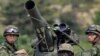



North Korea has issued a fresh threat to retaliate if South Korea goes ahead with its latest planned artillery exercise in the Yellow Sea.
Pyongyang's official news agency quotes the military as saying "second and third self-defensive blows that cannot be predicted will be dealt" if South Korea holds a live-fire drill on Yeonpyeong island.
South Korea says that between Saturday and Tuesday, depending on weather and other conditions, it will hold an artillery drill on the island.
A professor at South Korea's National Defense University, Choi Jong-Cheol, considers the new threat to be mostly bluster.
The professor says no one slaps the cheek of a person who has already been crying. South Korea, he says, is asserting its right of self-defense and thus it is total nonsense for North Korea to object to a planned exercise in the South's own territory.
Hours after a similar exercise on November 23 on Yeonpyeong, North Korea shelled the island, setting homes on fire and killing two South Korean marines and two civilians.
The North Korean statement says "the intensity and range" of its next strikes will be greater than the November 23rd attack.
North Korea considers South Korean exercises on the western frontier provocative because they include waters close to the Northern Limit Line, the maritime border that Pyongyang has never recognized.
South Korea's leaders have vowed to carry out retaliatory strikes on North Korea should it launch another attack similar to the bombardment of Yeonpyeong island.
Professor Choi expresses little doubt South Korea will make good on that vow.
He says it is all set. The defense ministry, the president and the South Korean public are ready for a fight. If the North Koreans really attack again, he predicts, South Korea will smash them.
Tension between the two Koreas is at its highest level in many years.
The relationship began to deteriorate following the sinking last March of a South Korean naval ship in the Yellow Sea. South Korea, the United States and other countries concluded that a North Korean torpedo hit the Cheonan, causing it to explode, killing 46 people.
North Korea also recently revealed a uranium enrichment program, which could give it a new way to produce nuclear weapons.
The latest threat of retaliation from Pyongyang comes as Bill Richardson, the governor of the U.S. state of New Mexico is in North Korea, meeting with government officials.
Richardson, who is on an unofficial trip, told the CNN news network on Friday he has made some progress in his quest to ease what he says is the highest level of tension he has seen.
The former ambassador to the United Nations has been to North Korea six times before.
Neither Seoul nor Washington has diplomatic relations with Pyongyang. The two Koreas never signed a peace treaty following the three-year war they fought in the early 1950's. An armistice has regulated a tenuous ceasefire since then.
N. Korea Says Live-Fire Drill Will Prompt Another Attack