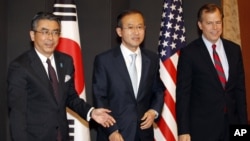
SEOUL - A high-level U.S. delegation focused on North Korean matters met with South Korean and Japanese diplomats in Seoul Monday. The group had words of warning for North Korea.
Key U.S., South Korean and Japanese diplomats held talks for the first time since North Korea's provocative rocket launch attempt last month. The rocket exploded less than two minutes into its flight.
Host envoy Lim Sung-nam said if Pyongyang is willing to take a different path it would "lead North Korea to the right side of peace."
Pledge of unified response
But the diplomats are also pledging a unified response should Pyongyang go ahead with any more provocations, such as a third attempted nuclear test.
Glyn Davies, the U.S. special envoy for North Korea policy, warned Pyongyang that such an act would prove to be a serious miscalculation.
"This new regime in Pyongyang saw that the world community, the international community, was united in reacting to the missile launch on April 13th," he said. "And so they know if they engage in another provocation, such as a nuclear test, they will once again be subject to a united action by the international community."
After the failed launch, which Pyongyang termed an attempt to peacefully place a satellite into space, the U.N. Security Council imposed sanctions against three additional North Korean entities linked to the impoverished country's ballistic missile development.
Sanctions
Diplomats on Monday said further provocations would mean more sanctions imposed by the world body. But the senior Japanese diplomat for Asia affairs, Shinsuke Sugiyama, declined to elaborate on how else Pyongyang might be punished.
"It is in that context that we certainly did extensively exchange views of each one, of analysis about how things look like and how things are likely to happen - or unlikely to happen. But I don't think I can be in a position to disclose all of the substantive elements of the discussions," said Shinsuke Sugiyama.
At their summit Saturday at Camp David, Group of Eight world leaders issued a declaration warning North Korea it will face more sanctions should it continue to threaten the stability of the region.
North Korea conducted rocket launches, followed by nuclear tests, in 2006 and 2009. Thus, there is speculation that this year's launch attempt will also be followed by a nuclear detonation.
Secret US mission?
Less than a week before the latest launch, a U.S. delegation is believed to have made a secret one-day trip to Pyongyang.
U.S. envoy Davies was asked about that clandestine journey by reporters Monday at South Korea's foreign ministry.
"I don't have anything for you on that. I understand your need to ask those questions, but I can't help you," he said.
An Internet news channel says South Korea's military air traffic controllers were initially unable to identify the secret April flight because they were not notified in advance that a U.S. jet would be transiting their air space and flying into North Korea.
The online KBS Reset says the Americans were hoping to convince the North Koreans not to go ahead with the planned launch of a multi-stage rocket from the new Sohae space center.
Davies and other U.S. officials plan to meet Tuesday in Beijing with China's chief nuclear envoy, Wu Dawei. They head to Japan the following day for talks in Tokyo.
Also on the Asia trip are the Deputy Assistant Secretary of State for Japan and Korean Affairs, Jim Zumwalt, and Ambassador Ford Hart, the State Department's envoy in charge of the long-stalled six-party talks about North Korea's nuclear programs. They are joined by the Korea policy chief at the White House, Syd Seiler, who spent nearly 30 years in the intelligence community focused on North Korea.
Key U.S., South Korean and Japanese diplomats held talks for the first time since North Korea's provocative rocket launch attempt last month. The rocket exploded less than two minutes into its flight.
Host envoy Lim Sung-nam said if Pyongyang is willing to take a different path it would "lead North Korea to the right side of peace."
Pledge of unified response
But the diplomats are also pledging a unified response should Pyongyang go ahead with any more provocations, such as a third attempted nuclear test.
Glyn Davies, the U.S. special envoy for North Korea policy, warned Pyongyang that such an act would prove to be a serious miscalculation.
"This new regime in Pyongyang saw that the world community, the international community, was united in reacting to the missile launch on April 13th," he said. "And so they know if they engage in another provocation, such as a nuclear test, they will once again be subject to a united action by the international community."
After the failed launch, which Pyongyang termed an attempt to peacefully place a satellite into space, the U.N. Security Council imposed sanctions against three additional North Korean entities linked to the impoverished country's ballistic missile development.
Sanctions
Diplomats on Monday said further provocations would mean more sanctions imposed by the world body. But the senior Japanese diplomat for Asia affairs, Shinsuke Sugiyama, declined to elaborate on how else Pyongyang might be punished.
"It is in that context that we certainly did extensively exchange views of each one, of analysis about how things look like and how things are likely to happen - or unlikely to happen. But I don't think I can be in a position to disclose all of the substantive elements of the discussions," said Shinsuke Sugiyama.
At their summit Saturday at Camp David, Group of Eight world leaders issued a declaration warning North Korea it will face more sanctions should it continue to threaten the stability of the region.
North Korea conducted rocket launches, followed by nuclear tests, in 2006 and 2009. Thus, there is speculation that this year's launch attempt will also be followed by a nuclear detonation.
Secret US mission?
Less than a week before the latest launch, a U.S. delegation is believed to have made a secret one-day trip to Pyongyang.
U.S. envoy Davies was asked about that clandestine journey by reporters Monday at South Korea's foreign ministry.
"I don't have anything for you on that. I understand your need to ask those questions, but I can't help you," he said.
An Internet news channel says South Korea's military air traffic controllers were initially unable to identify the secret April flight because they were not notified in advance that a U.S. jet would be transiting their air space and flying into North Korea.
The online KBS Reset says the Americans were hoping to convince the North Koreans not to go ahead with the planned launch of a multi-stage rocket from the new Sohae space center.
Davies and other U.S. officials plan to meet Tuesday in Beijing with China's chief nuclear envoy, Wu Dawei. They head to Japan the following day for talks in Tokyo.
Also on the Asia trip are the Deputy Assistant Secretary of State for Japan and Korean Affairs, Jim Zumwalt, and Ambassador Ford Hart, the State Department's envoy in charge of the long-stalled six-party talks about North Korea's nuclear programs. They are joined by the Korea policy chief at the White House, Syd Seiler, who spent nearly 30 years in the intelligence community focused on North Korea.