Independent astronomers say North Korea's newly launched satellite may be malfunctioning, tumbling end over end instead of pointing consistently at the Earth. It also is allegedly failing to emit expected ultra high-frequency radio broadcasts.
Dr. Jonathan McDowell of the Harvard-Smithsonian Center for Astrophysics told VOA Monday that optical observers from around the world have been using orbital data to predict the satellite's movements. They also have been measuring its brightness.
He said multiple reports, notably one from retired South African astronomer Greg Roberts, indicate the satellite is alternately getting brighter and fainter in 16-second intervals, which suggests to McDowell and other scientists that the satellite is tumbling in orbit.
"The box is tumbling end over end, so when it catches the sunlight it gets brighter, when it's facing the other way it gets fainter, McDowell said. That leads us further to conclude the satellite isn't working right. It's designed so that it should always point toward the Earth so it can use its little webcam to take pictures of the Earth," he said.
McDowell said another troubling sign - the absence of ultra high-frequency radio broadcasts North Korea said would be emitted from the satellite - was flagged by Bob Christy with the Kettering Group of amateur satellite observers in the United Kingdom.
"People have been looking for the claimed patriotic songs that the satellite is meant to be broadcasting over radio, and no one has been able to pick those up. So we think that part isn't working either," McDowell said.
The United States Strategic Command, which tracks and identifies all man-made objects in Earth's orbit, referred all inquiries about the reports to the U.S. Defense Department, which declined to comment.
The South Korean defense ministry said it typically takes about two weeks to determine whether a satellite works successfully after liftoff, citing data from the North American Aerospace Defense Command, or NORAD.
The North Koreans launched the satellite toward a sun-synchronous orbit over the North and South poles, which is consistent with orbiters that would image the Earth. According to McDowell, that is a tip-off that Pyongyang's ultimate goal is to develop a spy satellite, which he said would require a somewhat larger rocket.
"The path they've chosen to put the satellite in suggests that they're interested in it as a pathfinder for a future, bigger [orbiter] that might be observing the Earth. The obvious reason the North Koreans would want to observe the Earth is to have an independent spy satellite capability," said McDowell.
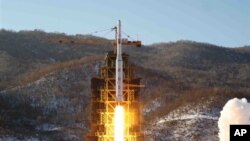
North Korea called last week's launch "groundbreaking" and "peaceful" with the aim of placing a weather satellite into orbit. It was carried out despite warnings from the United Nations and the United States. The event is being viewed by most of the world as a violation of U.N. Security Council resolutions.
Seoul, Tokyo, Washington and the United Nations immediately condemned the launch.
Dr. Jonathan McDowell of the Harvard-Smithsonian Center for Astrophysics told VOA Monday that optical observers from around the world have been using orbital data to predict the satellite's movements. They also have been measuring its brightness.
He said multiple reports, notably one from retired South African astronomer Greg Roberts, indicate the satellite is alternately getting brighter and fainter in 16-second intervals, which suggests to McDowell and other scientists that the satellite is tumbling in orbit.
"The box is tumbling end over end, so when it catches the sunlight it gets brighter, when it's facing the other way it gets fainter, McDowell said. That leads us further to conclude the satellite isn't working right. It's designed so that it should always point toward the Earth so it can use its little webcam to take pictures of the Earth," he said.
McDowell said another troubling sign - the absence of ultra high-frequency radio broadcasts North Korea said would be emitted from the satellite - was flagged by Bob Christy with the Kettering Group of amateur satellite observers in the United Kingdom.
"People have been looking for the claimed patriotic songs that the satellite is meant to be broadcasting over radio, and no one has been able to pick those up. So we think that part isn't working either," McDowell said.
The United States Strategic Command, which tracks and identifies all man-made objects in Earth's orbit, referred all inquiries about the reports to the U.S. Defense Department, which declined to comment.
The South Korean defense ministry said it typically takes about two weeks to determine whether a satellite works successfully after liftoff, citing data from the North American Aerospace Defense Command, or NORAD.
The North Koreans launched the satellite toward a sun-synchronous orbit over the North and South poles, which is consistent with orbiters that would image the Earth. According to McDowell, that is a tip-off that Pyongyang's ultimate goal is to develop a spy satellite, which he said would require a somewhat larger rocket.
"The path they've chosen to put the satellite in suggests that they're interested in it as a pathfinder for a future, bigger [orbiter] that might be observing the Earth. The obvious reason the North Koreans would want to observe the Earth is to have an independent spy satellite capability," said McDowell.
North Korea called last week's launch "groundbreaking" and "peaceful" with the aim of placing a weather satellite into orbit. It was carried out despite warnings from the United Nations and the United States. The event is being viewed by most of the world as a violation of U.N. Security Council resolutions.
Seoul, Tokyo, Washington and the United Nations immediately condemned the launch.