


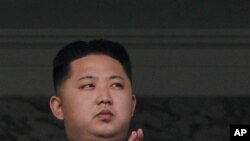
Spectacular public shows in recent days in Pyongyang have left little doubt in North Korea - or other countries - that a succession of power is under way there. Kim Jong Un, believed to be 27, has made prominent appearances alongside his father, leader Kim Jong Il. The elder Kim, nearing 70, has had serious health problems in recent years.
A parade marks the 65th anniversary of the founding of North Korea's only political party. It makes clear the relationship between the party and the army.
The reclusive government allowed in foreign cameras to record Sunday's parade of soldiers and missiles, which official media called a demonstration of North Korea's "intention to destroy the enemy."
Joining leader Kim Jong Il on the reviewing stand was the country's youngest general.
North Korea experts say Kim Jong Un's position next to his father and military leaders indicates the older generals' loyalty to the heir apparent and signals that a transition is under way.
South Korean President Lee Myung-bak agrees.
"It's now clear that the North Korea is heading to the dynastic succession in the third generation. However, we have to keep watching the process and we will be closely monitoring it," said President Lee.
Regional experts say Kim Jong Un is being pushed into senior positions to prepare him to run the country. He faces tough challenges, including demands from most of the world to halt North Korea's nuclear weapons programs.
The strongest such demands come from South Korea and the United States.
Their North Korea policies, in part, are built around an expectation of an eventual failure of Kim family rule.
But Professor Tong Kim of Johns Hopkins University's School for Advanced International Studies calls that an assumption without evidence.
"And I think it will be too risky, too dangerous, stakes will be too high to just have our policy rely on the speculation of what might happen in North Korea," noted Professor Kim.
What is more certain, says Professor Kim, is that Kim Jong Un will be the next ruler of North Korea.
"I think he will have the control of the decision-making system and he will be the leader," added Professor Kim.
Beijing has invited Kim Jong Il, his son and others in the ruling line-up to visit China "whenever convenient." That is interpreted as an endorsement from North Korea's sole remaining powerful friend for the power transfer from father to son.