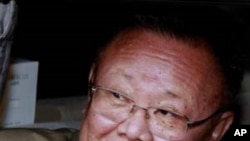
North Korean leader Kim Jong-Il is making another push to restart nuclear disarmament talks in the hopes of getting aid for his impoverished country.
China's state-run media Friday said the North Korean leader told a China's State Counselor Dai Bingguo he was willing to go ahead with a nuclear test and production ban without any preconditions.
The latest offer to restart six-party talks came during a visit to China's Heilongjiang province as Mr. Kim makes his way back home after a visit to Russia.
The North Korean leader's proposal echoes the offer he made Wednesday to Russian President Dmitry Medvedev.
The United States and South Korea, which both participated in earlier rounds of six-party negotiations, along with Russia, China and Japan, dismissed that proposal as nothing new. Washington and Seoul have insisted for months that the North must dismantle its nuclear programs before any further talks can take place.
Mr. Kim left Russia for China Thursday, travelling in his armored train.
The quick reports on Mr. Kim's discussions with Chinese officials are unusual. China's state-run media normally reports on the North Korean leader's visit only after he has left the country.
Mr. Kim last visited China in May. During that trip he visited several factories and manufacturing sites that could serve as models for Pyongyang as its attempts to repair its own tattered economy.
North Korea walked away from the six-party talks in 2008 and stepped up its nuclear weapons and ballistic missile testing. Pyongyang also displayed sophisticated uranium enrichment facilities to a visiting U.S. scientist late last year.
Pyongyang's push to reopen talks comes as witnesses and surveillance depict deteriorating economic conditions in the North, including mass food shortages blamed on an unusually harsh winter and recent flooding.
South Korea's chief nuclear negotiator arrived in Beijing Thursday for talks with Chinese officials that were set to deal with the North's proposal to freeze its nuclear weapons and missile programs if six-nation talks are resumed.
North Korea's Kim Pushes China for New Nuclear Talks