



New satellite images show North Korea has resumed construction on a new nuclear reactor, despite international criticism.
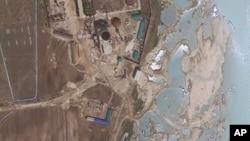
The U.S.-Korea Institute, operated by Johns Hopkins University's Paul H. Nitze School of Advanced International Studies (SAIS), says images taken by a commercial satellite on April 30 show Pyongyang has made progress on a light water reactor at its main nuclear complex at Yongbyon.
North Korea says the reactor is intended to generate electricity, but in a blog post on its website, the institute says the reactor clearly indicates Pyongyang's intention "to move forward" on expanding its nuclear weapons stockpile.
But the blog entry also says the new reactor will probably not be operational until 2014 or 2015.
Pyongyang first disclosed construction of the new reactor to a group of visiting U.S. scientists in 2010. It had made significant progress by late 2010, when work was halted. SAIS says the work may have stopped in part because of the death of longtime leader Kim Jong Il.
The research institute's findings could increase concerns that the North will conduct a third nuclear test.
South Korea, Japan and the United States will hold high-level diplomatic talks in Seoul next week about North Korea.
A spokesman for South Korea's foreign ministry says Lim Sung-nam, South Korea's ambassador for the nuclear issue, will host Japanese counterpart Shinsuke Sugiyama and U.S. special envoy to North Korea Glyn Davies in a discussion of developments on the peninsula after Pyongyang's failed missile launch on April 13.
The three nations are part of the multi-party talks, along with China and Russia, that are negotiating with North Korea to disband its nuclear program in exchange for economic and humanitarian aid.
The United States and North Korea reached an agreement in February for the North to suspend its nuclear weapons and missile programs, in exchange for food aid. Washington scrapped the deal after the missile launch, arguing it was a test of a long-range ballistic missile. Pyongyang said the launch was to place a weather satellite into orbit.
The U.S.-Korea Institute, operated by Johns Hopkins University's Paul H. Nitze School of Advanced International Studies (SAIS), says images taken by a commercial satellite on April 30 show Pyongyang has made progress on a light water reactor at its main nuclear complex at Yongbyon.
North Korea says the reactor is intended to generate electricity, but in a blog post on its website, the institute says the reactor clearly indicates Pyongyang's intention "to move forward" on expanding its nuclear weapons stockpile.
But the blog entry also says the new reactor will probably not be operational until 2014 or 2015.
Pyongyang first disclosed construction of the new reactor to a group of visiting U.S. scientists in 2010. It had made significant progress by late 2010, when work was halted. SAIS says the work may have stopped in part because of the death of longtime leader Kim Jong Il.
The research institute's findings could increase concerns that the North will conduct a third nuclear test.
South Korea, Japan and the United States will hold high-level diplomatic talks in Seoul next week about North Korea.
A spokesman for South Korea's foreign ministry says Lim Sung-nam, South Korea's ambassador for the nuclear issue, will host Japanese counterpart Shinsuke Sugiyama and U.S. special envoy to North Korea Glyn Davies in a discussion of developments on the peninsula after Pyongyang's failed missile launch on April 13.
The three nations are part of the multi-party talks, along with China and Russia, that are negotiating with North Korea to disband its nuclear program in exchange for economic and humanitarian aid.
The United States and North Korea reached an agreement in February for the North to suspend its nuclear weapons and missile programs, in exchange for food aid. Washington scrapped the deal after the missile launch, arguing it was a test of a long-range ballistic missile. Pyongyang said the launch was to place a weather satellite into orbit.
Some information for this report was provided by AP, AFP and Reuters.