


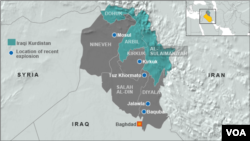
Iraqi authorities say bombings and shootings across the country have killed at least 26 people, about half of them in northern regions whose territory is disputed between autonomous Iraqi Kurds and Baghdad's central government.
In one of Monday's deadliest attacks, a car bomb killed seven people in a village near the northern city of Mosul in Iraq's Nineveh province. The village is inhabited by the Shabak ethnic minority.
Another two car bombs exploded in a Shi'ite district of the town of Tuz Khormato in Salah al-Din province, killing five people. Several bombs also went off around the town of Baquba in Diyala province, killing one person.
Disputed regions
Nineveh, Salah al-Din and Diyala provinces all border Iraq's autonomous Kurdish region, which wants to incorporate Kurdish-populated parts of those provinces into its territory, over Baghdad's strong objections.
There were no immediate claims of responsibility for the attacks, which marked the second consecutive day of violence in internally-disputed regions claimed by Iraqi Kurdistan.
Kirkuk provincial governor Najmaldin Karim told VOA that authorities believe al-Qaida terrorists carried out the latest attacks to try to enflame sectarian tensions and political differences between Iraqi Kurdistan and the federal government.
"There have been terrorist activities in these areas many time before," Karim said. "The pattern [of the latest attacks] is similar to what [al-Qaida] has done in the past, and the targeted areas are places in which they are active."
On Sunday, bombs targeting Iraqi Shi'ites killed at least six people in the oil-rich city of Kirkuk, home to a mix of ethnic Arabs, Kurds and Turkmen. A car bomb also struck a Patriotic Union of Kurdistan office in the Diyala town of Jalawla, killing two recruits seeking to join a Kurdish peshmerga security force.
Some of the Kirkuk blasts happened near Shi'ite mosques. Speaking by phone from Kirkuk, Karim said militants often switch their targets between Shi'ite and Kurdish areas. "It just depends on where they get the opportunity and where they can create more mistrust between the communities," he said.
Iraqi challenges
The withdrawal of U.S. forces from Iraq in December 2011 has made it tougher for their Iraqi government allies to secure the country. "A vacuum was left," Karim said. "Some of the listening and surveillance capabilities [of the U.S. forces] no longer exist. We are trying to train our police so that they can manage to combat those terrorist groups."
Karim also called for better coordination between Baghdad and provincial governments in training Iraqi security forces.
At least 13 people were killed in Monday's other attacks in Iraq. Two car bombs went off in different parts of the Iraqi capital, killing six people at a car dealership and one person in downtown Baghdad.
In one of Monday's deadliest attacks, a car bomb killed seven people in a village near the northern city of Mosul in Iraq's Nineveh province. The village is inhabited by the Shabak ethnic minority.
Another two car bombs exploded in a Shi'ite district of the town of Tuz Khormato in Salah al-Din province, killing five people. Several bombs also went off around the town of Baquba in Diyala province, killing one person.
Disputed regions
Nineveh, Salah al-Din and Diyala provinces all border Iraq's autonomous Kurdish region, which wants to incorporate Kurdish-populated parts of those provinces into its territory, over Baghdad's strong objections.
There were no immediate claims of responsibility for the attacks, which marked the second consecutive day of violence in internally-disputed regions claimed by Iraqi Kurdistan.
Kirkuk provincial governor Najmaldin Karim told VOA that authorities believe al-Qaida terrorists carried out the latest attacks to try to enflame sectarian tensions and political differences between Iraqi Kurdistan and the federal government.
"There have been terrorist activities in these areas many time before," Karim said. "The pattern [of the latest attacks] is similar to what [al-Qaida] has done in the past, and the targeted areas are places in which they are active."
On Sunday, bombs targeting Iraqi Shi'ites killed at least six people in the oil-rich city of Kirkuk, home to a mix of ethnic Arabs, Kurds and Turkmen. A car bomb also struck a Patriotic Union of Kurdistan office in the Diyala town of Jalawla, killing two recruits seeking to join a Kurdish peshmerga security force.
Some of the Kirkuk blasts happened near Shi'ite mosques. Speaking by phone from Kirkuk, Karim said militants often switch their targets between Shi'ite and Kurdish areas. "It just depends on where they get the opportunity and where they can create more mistrust between the communities," he said.
Iraqi challenges
The withdrawal of U.S. forces from Iraq in December 2011 has made it tougher for their Iraqi government allies to secure the country. "A vacuum was left," Karim said. "Some of the listening and surveillance capabilities [of the U.S. forces] no longer exist. We are trying to train our police so that they can manage to combat those terrorist groups."
Karim also called for better coordination between Baghdad and provincial governments in training Iraqi security forces.
At least 13 people were killed in Monday's other attacks in Iraq. Two car bombs went off in different parts of the Iraqi capital, killing six people at a car dealership and one person in downtown Baghdad.