



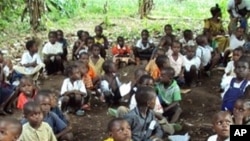
A letup in fighting around the Democratic Republic of Congo’s northwestern Equateur province has let U.N. relief officials regain access to 35,000 destitute refugees. The displaced civilians are part of a wider group of 114,000 victims who have crossed the Oubangui River since October to escape ethnic clashes between Congolese militias in an expansive fishing and farming dispute that forced authorities to call in the army.
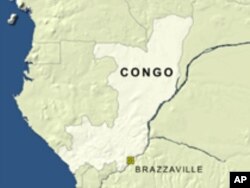
Rescuers had to fly supplies to the neighboring Republic of Congo (ROC), 700 kilometers north of its capital, Brazzaville, and transport the goods by barge along the river to more than 100 makeshift aid stations. UNHCR communications officer Fatoumata Lejeune-Kaba says the exodus has posed a logistically challenging rescue effort that planners estimate could cost about $59,000,000.
“We have received some funding, about $17,000,000, but we do need more to cater to the needs of all the refugees. They are so widely dispersed that it is a very expensive logistical operation,” she pointed out.
For refugees camped out along the Oubangui between the Congo Republic’s regional capital of Impfondo and the town of Liranga, the past five weeks of renewed shooting and fighting between the army and ethnic militias prevented humanitarian workers from reaching uprooted civilians.
Deadly militia assaults on the DRC town of Mbandaka in early April also accelerated the arrival of victims in the Congo Republic, seeking food, shelter, water, education, and health care, which could not be delivered until the shooting stopped.
“Fortunately, we were able to reach the refugees after security restrictions were lifted for U.N. staff to travel on the southern axis of the Oubangui River, where the Congolese military operation was ongoing. So, it was where the DR Congolese army operations tried to stop the militiamen, whose deadly assaults prompted all this huge refugee flow,” said Lejeune-Kaba.
She added that, with almost a doubling of its population in the past six months, the northern Republic of Congo is facing a crisis of enormous proportions, and the challenges of delivering aid to those in need differ widely from more conventional rescue efforts.
“Every single one of the refugee sites can only be reached by the river, so we have to hop from one site to another. Some of them are very close by. But, there are about 100 sites on 600 kilometers. It’s like a site every six kilometers, and every one of our efforts is multiplied by the number of sites. If we’re going to distribute food, it’s going to be distributed in 100 sites. If you’re going to distribute, say, mosquito nets, you’re going to do it in 100 different locations,” she explained.
Although the displaced remain reluctant to return home so soon after an uneasy calm has settled on northwestern Equateur, the UNHCR spokeswoman says the agency will continue to fulfill its mission of standing by the victims as long as its international mandate permits the agency to assist the refugees, either by supplying emergency relief or by facilitating their return to their former homes.
“So far, we continue to engage with donors, and there are a lot of donor missions. And, they seem to be showing support for our operations. And, we just hope that will continue, especially when we enter the period of the year where navigating along the Oubangui River is a lot easier, which means we can reach a lot more people,” she explained.
By last week, UNHCR staff had succeeded in registering about 70,000 of the DRC population residing in neighboring Republic of Congo. It’s estimated that an additional 30,000 Congolese are remaining inside Equateur province as internally uprooted civilians. UNHCR is also planning to reinforce its presence in the DRC to care for their needs.