



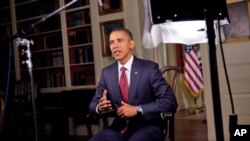
The spread of nuclear weapons is expected to be one of the main issues U.S. President Barack Obama addresses when he speaks to the United Nations General Assembly on Thursday (September 23).
When President Obama takes his turn speaking to the United Nations, many of the topics he covers will be familiar, according to White House press secretary Robert Gibbs.
He said Friday nuclear proliferation will be high on the list. "Many of the issues that we talked about last year at the United Nations remain on the docket-concern about Iran, concern about North Korea," he said.
In his 2009 U.N. address, Mr. Obama put Iran and North Korea on notice for their nuclear activities. "But if the governments of Iran and North Korea choose to ignore international standards; if they put the pursuit of nuclear weapons ahead of regional stability and the security and opportunity of their own people; if they are oblivious to the dangers of escalating nuclear arms races in both East Asia and the Middle East, then they must be held accountable," he said.
In the year that followed, there were no public signs that North Korea was ready to return to the six-party talks on its nuclear program. Pyongyang walked away from those talks in April, 2009.
The United Nations imposed a fourth set of sanctions on Iran in June for refusing to stop enriching uranium. The U.S. accuses Iran of consistently violating U.N. sanctions.
The U.S. has made greater progress in the past year in working with Russia to shrink the two former Cold War rivals' nuclear arsenals, one of the main points in the president's U.N. speech last year. "We will pursue a new agreement with Russia to substantially reduce our strategic warheads and launchers," he said.
Mr. Obama and Russian President Dmitry Medvedev signed the New START treaty last April in Prague. The U.S. Senate Foreign Relations Committee approved the treaty on Thursday. The agreement still requires ratification from the full Senate and the Russian Duma.
Robert Gibbs said Friday this treaty will also figure prominently in Mr. Obama's U.N. address. "We go having made progress yesterday on a START treaty that we still believe that the Senate will ratify before the end of the year and mark an important accomplishment on both nations' path towards reducing our stockpile of nuclear weapons," he said.
As the president pledged last year, his administration has also completed a new Nuclear Posture Review and hosted a summit on securing nuclear material, so-called loose nukes. But the U.S. Senate has not ratified the Comprehensive Test Ban Treaty.
The president will likely devote part of his U.N. speech to the Middle East peace process, as he did last year. "The time has come to re-launch negotiations, without preconditions, that address the permanent-status issues: security for Israelis and Palestinians; borders, refugees and Jerusalem," he said.
With U.S. mediation, the two sides have recently begun a new round of talks, with the goal of agreeing on all major issues within a year.
Mr. Obama will likely mention American involvement in Iraq, as in 2009. "We have removed American combat brigades from Iraqi cities, and set a deadline of next August to remove all our combat brigades from Iraqi territory," he said previously.
That deadline was met, and the roughly 50,000 U.S. troops who remain in Iraq are performing civilian duties but ready for combat if necessary.
On the sidelines of the General Assembly session, Mr. Obama will hold a number of bilateral meetings with other world leaders.
Among others, the president will sit down separately with Chinese Premier Wen Jiabao and Japanese Prime Minister Naoto Kan. He will aslo meet with ASEAN leaders.