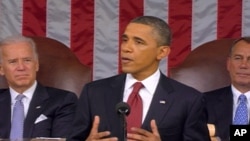
President Barack Obama devoted a relatively small portion of his State of the Union Address on Tuesday to U.S. foreign policy issues. Mr. Obama emphasized progress against al-Qaida and support for the Arab Spring democracy movement, and responded to criticism from Republican presidential hopefuls that America's global influence has declined under his leadership.
Foreign policy did not dominate the speech, but what Mr. Obama did say underscored what he sees as successes, including his approach to the Middle East's Arab Spring.
The president began by noting that for the first time since 2003, no Americans are fighting in Iraq. He also recalled that Osama bin Laden no longer threatens the United States and that top al-Qaida leaders have been "defeated."
He said that in Afghanistan, the momentum of the Taliban has been broken, with U.S. troops beginning to withdraw and a transition to Afghan-led security underway.
Joseph Cirincione, a foreign policy and nuclear proliferation expert who has advised the Obama administration, says Mr. Obama's focus on foreign policy successes were an effort to emphasize "a surprisingly strong national security record."
"That he has got a very strong record on national security and that Republican charges that he is weak or naive or dangerous or doesn't care about American security, or might not even be an American, are going to fall flat. And he came out with not just a robust defense, but an offense on these issues," Cirincione said.
On Iran and the impasse over its nuclear program, President Obama repeated familiar policy positions. "Crippling" sanctions," he said, have left Iran's leadership "more isolated than ever," adding that he is taking no options off the table regarding efforts to prevent Iran from obtaining a atomic weapon.
But as he did at the beginning of his presidency, Mr. Obama also offered Iran's leadership the prospect of improved relations with the United States. "But a peaceful resolution of this issue is still possible, and far better. And if Iran changes course and meets its obligations, it can rejoin the community of nations," he said.
Joseph Cirincione, president of the Ploughshares Fund, a Washington-based global security foundation, says this is part of an Iran strategy by Mr. Obama that is "deeper" and more complex than many people realize.
"It was key that the president was offering this diplomatic solution -- 'Come back to the table, we can work out an arrangement. You don't have to down this nuclear course. It doesn't have to end militarily; it doesn't have to continue to be Iran being isolated in the world. There is a way out,'" Cirincione said.
Analyst Daniel Serwer of The Johns Hopkins School of Advanced International Studies says that with U.S. and European sanctions looming, Iran's leadership might not view Mr. Obama's remarks as a peaceful overture.
"The Republican [presidential] candidates [i.e., contenders] may portray the president as weak, but I don't think that is what the Iranians are seeing. They're seeing a very strong diplomatic effort in the form of sanctions coming down on their head," Serwer said.
President Obama recognized the open-endedness of the democratic movement in the Mideast, but he reaffirmed that the United States is firmly on the side of change.
It was notable, say analysts, that he combined remarks about the death of Moammar Gadhafi, with the situation in Syria, where at least 5,000 people are thought to have died in what many observers describe as a civil war.
"And in Syria, I have no doubt that the [Bashar al-] Assad regime will soon discover that the forces of change can’t be reversed, and that human dignity can’t be denied," the president said.
Absent from the State of the Union Address was any mention of North Korea, where another transition is underway with the accession of leader Kim Jong Un, as well as the troubled Israel-Palestinian peace efforts and the European debt crisis -- a particular concern for Mr. Obama because of its affect on the U.S. economy.
"It seems to me very significant that a lot was left out and that the president is trying to refocus away from broad international commitments and toward some very specific, mostly domestic commitments," Serwer said.
The president did focus on a sensitive domestic issue for him -- China's trade practices -- when he announced his intention to create a Trade Enforcement Unit to investigate unfair trade practices.
In discussing the U.S. economy, Mr. Obama stressed his determination to ensure that U.S. manufacturing and development of alternative energy industries do not lose out to foreign competition, again mentioning China along with Germany.
Obama Highlights Foreign Policy Achievements in State of Union Address