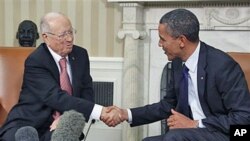
In his first White House meeting with a leader of an Arab Spring country, President Barack Obama and Tunisian Prime Minister Beji Caid Essebsi discussed that country's democratization process and economic needs.
Tunisia was the spark for the wave of popular uprisings that spread across North Africa and the Middle East, leading to the ouster of long-time dictatorial leaders in Egypt and Libya, demonstrations in Yemen, Bahrain, and Syria, with global repercussions.
Essebsi was a key official in the former government, and has led Tunisia since former Tunisian dictator Zine el Abidine Ben Ali was ousted early this year.
The Oval Office meeting was President Barack Obama's first there with an Arab Spring leader. The president met in New York last month with Libyan Transitional National Council leaders attending the U.N. General Assembly.
The president said Tunisia, starting with the actions of a street vendor angered by government policies who took his own life, led the transformation in the region.
"Tunisia has been an inspiration to all of us who believe that each individual man and woman, has certain inalienable rights, and that those rights must be recognized in a government that is responsive, is democratic, in which free and fair elections can take place, and in which the rights of minorities are protected," said Obama.
Speaking through an interpreter, Prime Minister Essebsi said President Obama was the first leader to welcome the change that took place in Tunisia last February and its importance for the entire region.
Essebsi said the success of the Arab Spring across the entire region depends on its outcome in Tunisia.
"Up until now the Arab Spring is really only the Tunisian spring. So what I do hope is that this Arab Spring will not limit itself exclusively to Tunisia, and that it will spread throughout the region and that of course depends on the economic and political success of Tunisia," said Essebsi.
In two weeks, Tunisians will vote in the first elections held in any Arab Spring country, with more than 100 parties running candidates for a new national assembly that will write a constitution.
Obama's press secretary Jay Carney had this response in Friday's news briefing to a reporter asking about U.S. concerns that the democratic process in Tunisia could be derailed on the way to the October 23 elections.
"If you are asking me generally speaking in the whole region, is this process tenuous, well I think in general it has to be because this is significant, significant change," said Carney.
Laying out U.S. policy last May toward the Middle East and Arab Spring, Obama said Egypt and Tunisia would be the focus of a new U.S. effort to promote reform across the region.
The U.S. with international partners and financial institutions are working on economic stabilization programs and debt relief, and "enterprise funds" to boost investment in Tunisia and Egypt.
Saying the United States has an "enormous stake" in Tunisia's success, Obama said he and Essebsi discussed a package of loan guarantees and other assistance, on top of $39 million provided so far, to encourage investment and offer more opportunities for young people to find jobs.
Opinion polls in Tunisia say an Islamist party could get the most votes in the upcoming elections.
In recent media interviews, Essebsi underscored the importance of gradual reforms and tolerance in Tunisia's political process, and sought to ease concerns about election gains by Islamists.
Obama Holds First White House Meeting With Arab Spring Leader
- By Dan Robinson