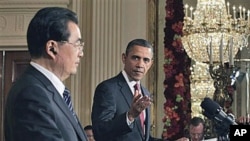
President Barack Obama and China's President Hu Jintao have held wide ranging talks at the White House on the first full day of Mr. Hu's state visit. The two men used a joint news conference to talk about trade relations, security issues, and human rights.
The talks covered the full range of issues in a relationship both leaders described as marked by great possibilities for cooperation on common interests, but also issues on which they disagree.
Speaking to reporters following bilateral talks and a meeting he and President Hu had with American and Chinese business executives, President Obama said it has been shown that when the U.S. and China cooperate they can achieve substantial benefits.
Mr. Obama said he told President Hu that the Chinese currency, the yuan, remains under-valued and requires further adjustment so China can boost domestic demand and move faster toward a more market-oriented economy.
The president said the U.S. recognizes the need to spend less and export more, and spoke about hopes for China further loosening controls on its currency.
"We will continue to look for the value of China's currency to be increasingly driven by the market which will help ensure that no nation has an undue economic advantage," said President Obama.
Among a wide range of regional and global issues, the two leaders discussed the situation on the Korean peninsula, cooperation on sanctions against Iran over its nuclear program, and the recent referendum in southern Sudan.
A key focus was human rights. Earlier, at the formal welcoming ceremony for President Hu, President Obama issued a strong public call for respect for universal rights.
Mr. Obama later told reporters he made clear to President Hu the U.S. position on human rights, including freedom of speech, press, assembly, association and demonstration, and religion.
"The U.S. speaks up for these freedoms and the dignity of every human being, not only because it is part of who we are as Americans but we do so because we believe that by upholding these universal rights all nations including China will ultimately be more prosperous and successful," said Obama.
President Hu issued a strong defense of Beijing's policies, saying China is always committed to protection of human rights. But he acknowledged that China, as a developing country still in stages of reform, knows more progress needs to be made.
"China still faces many challenges in economic and social development, and a lot still needs to be done in China in terms of human rights," said President Hu.
Neither leader mentioned, nor did any reporter specifically ask about, whether they had discussed Liu Xiaobo, the imprisoned dissident who was awarded the Nobel Peace Prize.
Across the street from the White House, a collection of groups protested Beijing's policies on everything from Tibet to religious freedom.
President Obama said on Wednesday that China's peaceful rise as a strong, prosperous and successful nation is good for the United States and good for the world.
As he and President Hu met with business leaders, Mr. Obama referred to a need to move away from stereotypes about the U.S.- China trade relationship, and focused on the goal of expanding U.S. exports to China.
"With China's growing middle class, I believe that over the coming years we can more than double our exports to China and create more jobs here in the United States, he said.
The White House issued a statement announcing a package of export deals to China worth about $45 billion, helping to support according to the White House an estimated 235,000 U.S. jobs.
As President Obama and President Hu were meeting at the White House, China's economic and human rights policies were being criticized in a hearing of the House of Representatives Committee on Foreign Affairs.
Its chairwoman, Florida Republican Representative Ileana Ros-Lehtinen, criticized Beijing's policies on Iran and North Korea, and the South China Sea and for its treatment of Nobel laureate Liu Xiaobo.
The committee's ranking Democrat, Representative Howard Berman, praised China for its cooperation on sanctions against Iran, but said there is ample evidence that Chinese entities continue to invest in Iran’s energy sector.
Obama, Hu Have Candid Talks on Human Rights, Other Issues
- By Dan Robinson