


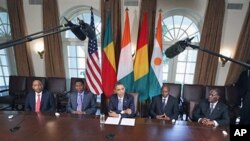
As he continues to deal with the U.S. debt crisis, President Barack Obama met on Friday with four visiting African heads of state. Obama said the leaders represent expanding democracy in Africa, and the discussions also covered issues such as counter-terrorism and famine in East Africa.
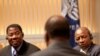
Obama's meeting with the presidents of Benin, Guinea, Niger, and Ivory Coast took place in the White House Cabinet Room rather than the Oval Office.
The president sat in the middle of the long table in the room flanked by Presidents Boni Yayi of Benin, Alpha Conde of Guinea, Mahamadou Issoufou of Niger, and Alassane Ouattara of Ivory Coast.
The talks were closed to media coverage, but in a fairly lengthy statement translated into French, Obama noted that all four men came to power through free and fair elections.
Calling democratic progress vital to a stable, prosperous and just Africa and critical to global stability, the president said each had shown persistence in the face of enormous challenges.
"Because of their fortitude and because of the determination of their people to live in democratic, free societies they have been able to arrive at a position of power that is supported by the legitimate will of their peoples and as such they can serve as effective models for the continent," Obama said.
Among those challenges, Obama mentioned Ivory Coast where Ouattara took power earlier this year following political upheaval and protracted fighting that left as many as 3,000 people dead.
In recognizing Ouattara as the new legitimate leader in Ivory Coast last April, replacing Laurent Gbagbo, Obama also called for steps toward reconciliation and said those responsible for atrocities should be held accountable.
The president repeated a theme he sounded during his only visit so far to Africa in 2009, and in interactions with African leaders, that "this is a moment of great opportunity and significant progress" for the continent.
He said all agreed that development "cannot keep on duplicating an approach that breeds dependence" but must embrace one that creates sustainability and greater capacity.
The talks also covered security issues. Obama said he expressed appreciation for assistance from African countries in battling terrorism that he said is "trying to get a foothold inside of Africa."
Spreading famine and humanitarian crisis in East Africa also was a topic, including how the U.S. can work with countries to prevent things from getting worse.
"I think it has not gotten as much attention here in the United States as it deserves, but we are starting to see famine developing along the Horn of Africa, in areas like Somalia in particular, and that is going to require an international response, and Africa will have to be a partner in making sure that tens of thousands do not starve to death," said the president.
President Obama noted that Niger's President Issoufou had mentioned Obama's upcoming 50th birthday. Obama used that to underscore another message he has sought to communicate to the people of Africa.
"When we think about the extraordinary progress that has been made, I think there is much that we can be proud of, but of course when we think about the last 50 years, we also have to recognize that there have been a lot of opportunities that have been missed," he said.
The president said he believes the leaders in the room are "absolutely committed" to making sure that 50 years from now they can say they helped to turn the tide in their countries, establish strong democratic practices, and establish economic prosperity and security.