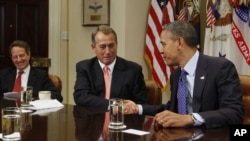
U.S. President Barack Obama and key congressional leaders are meeting Friday in their first face-to-face effort to resolve crucial government financial issues before the end of the year.
As the talks started, President Obama said he and the lawmakers would have to make "tough compromises" to keep the government from cascading over what Washington is calling a "fiscal cliff," a financial precipice of $600 billion in mandated spending cuts to key defense and domestic programs and higher taxes for American workers set to take effect January 1.
"Our challenge is to make sure that we are able to cooperate together, work together, find some common ground, make some tough compromises, build some consensus to do the peoples' business," Obama said. "And what the folks are looking for, and I think all of us agree on this, is action. They want to see that we are focused on them, not focused on our politics here in Washington."
Both Obama, the recently re-elected Democratic incumbent, and congressional Republicans agreed last year to set the end-of-2012 deadline to resolve the contentious tax and spending issues. Neither the White House nor Congress wants the spending curbs or higher taxes to take effect, but periodic attempts to reach a compromise have failed.
U.S. economists say that allowing spending cuts and higher tax rates to take effect could send the fragile American economy back into a recession and boost the country's jobless rate from 7.9 percent to above 9 percent. U.S. stock markets have retreated in recent days over fears that the dispute will not be resolved.
One focal point of the extended debate over U.S. financial policies is whether the wealthiest Americans should pay higher taxes. Obama has vowed to end the current tax break for households making more than $250,000 a year, but Republicans have been adamant in opposition.
The president is calling for $1.6 trillion in additional government revenue over the next decade. Republican leaders say some revenue can be raised through an improving economy and ending some current tax deductions, rather than raising tax rates.
Senate Democratic leader Harry Reid and the top Senate Republican, Mitch McConnell, joined the president at the White House meeting, along with the top Republican in the House of Representatives, John Boehner, and the House Democratic leader, Nancy Pelosi.
Earlier in the week, Obama met with American labor leaders and chief executives of major U.S. corporations about their priorities in resolving the policy stalemate. The president sought their support for what he has called a "balanced" mix of increased revenue for the government and spending cuts. His financial package is aimed at eventually reducing the country's accumulated $16 trillion in debt over the next decade.
Some information for this report was provided by AP and Reuters.