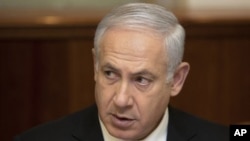



Before the Jewish Passover observance began on Monday, President Barack Obama spoke with Israeli Prime Minister Benjamin Netanyahu about Mideast peace efforts, counter-terrorism cooperation and other issues. The White House remains publicly silent on what Mr. Obama might say in the coming weeks about stalled Israel-Palestinian peace efforts.
As they have done for the past two years at the White House, the president and first lady Michelle Obama marked Passover with a Seder in the Old Family Dining Room, attended by Jewish and other guests.
A statement said President Obama made a Passover telephone call to Prime Minister Netanyahu to convey his best wishes, and he "recalled that the story of Passover is one of liberation and freedom, and expressed hope that the Israeli people would be able to celebrate in peace."
Press Secretary Jay Carney gave reporters more details about the conversation between Mr. Obama and Mr. Netanyahu. "The two leaders also discussed U.S.-Israeli cooperation on counterterrorism, how best to move forward in efforts to advance Middle East peace, and the recent violence near the Gaza Strip," Carney said.
President Obama and Prime Minister Netanyahu also discussed U.S. assistance for development of Israel's Iron Dome defense system, which will protect against rocket attacks of the kind Israel frequently faces from Gaza.
Mr. Obama congratulated Prime Minister Netanyahu on the "impressive Israeli technological achievement," which the president noted was supported this year with $205 million above the amount of regular U.S.-Israel military aid.
Although not mentioned in Monday's White House statement, Israeli news reports quoted President Obama as expressing gratitude to Mr. Netanyahu over the way Israel handled recent escalation of violence in Gaza.
What the White House has not discussed in public recently is how President Obama plans to get Israel-Palestinian peace efforts back on track, nearly nine months after the president began a drive for an Israel-Palestinian peace agreement last September.
Speaking at the U.S.-Islamic World Forum in Washington last week, Secretary of State Hillary Clinton said the United States is committed to "renewed pursuit" of a comprehensive Arab-Israeli peace.
"The status quo between Palestinians and Israelis is no more sustainable than the political systems that have crumbled in recent months. Neither Israel's future as a Jewish democratic state or the legitimate aspirations of Palestinians can be secured without a negotiated two state solution," she said.
Clinton repeated the U.S. position that only Israel and Palestinians can make hard choices necessary for peace, but said she and President Obama are committed to continued active American leadership.
The White House has remained silent about what Secretary Clinton described as President Obama's plan to speak "in greater detail" in coming weeks about U.S. policy in the Mideast and North Africa.
News reports have said Prime Minister Netanyahu has been preparing an initiative he plans to unveil when he comes to Washington next month to address a joint meeting of the U.S. Congress and talk with the American-Israel Public Affairs Committee.
In an interview with the Agence France Presse news service, Mr. Netanyahu declined to provide details, but he said the core issues remained Palestinians recognition of Israel as a Jewish state, and Israeli security alongside a future Palestinian state.
Asked whether the two men discussed Mr. Netanyahu's reported emerging initiative, National Security Council spokesman Tommy Vietor said only that the White House had nothing to add beyond Monday's description of the two leaders' Passover conversation.
Monday's written White House statement said only the two men "agreed to stay in close touch on the range of issues facing the United States and Israel."
Obama, Netanyahu Discuss Mideast Peace