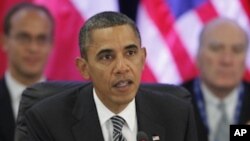
President Barack Obama has announced that the United States and eight other Pacific nations have reached the broad outlines of an agreement to create a Trans-Pacific Partnership to liberalize trade.
Negotiations aimed at finalizing the new trade group, composed of nations already members of the larger 21 member APEC group, have been going on for months.
Though the fine details and difficulty of the talks prevented any final agreement being announced in Honolulu, the conclusion of a framework for TPP was expected.
Mr. Obama said the accord, with a group of nations already doing some $200 billion in trade with the United States each year, will have benefits for all concerned. "The TPP will boost our economies, lowering barriers to trade and investment, increasing exports and creating more jobs for our people, which is my number one priority," he said.
Aside from the United States, other nations in TPP include Australia, New Zealand, Malaysia, Brunei, Singapore, Vietnam, Chile and Peru. Japan was expected to announce it would join.
The president said TPP nations have directed teams to complete work on "plenty of details" remaining so the agreement can be finalized within the coming year, and he voiced optimism this can be achieved.
Mr. Obama noted that APEC itself had years ago established a goal of establishing a Pacific-wide free trade area. TPP he said now has the potential to be a model, and addresses issues such as market regulation, workers rights, and the environment.
In remarks later as he met with business executives, Mr. Obama also spoke about developments in Europe.
The president said Europe as a whole must support its members, such as Italy and Greece, as they apply structural reforms to give confidence to markets. "We are not going to see massive growth out of Europe until the problem is resolved, and that will have a dampening effect on the overall global economy," he said.
Connecting European fiscal problems to the objectives of his nine-day Asia-Pacific trip, Mr. Obama said if European problems can be "contained" the Asia-Pacific region, with half of global trade and GDP , can be an "extraordinary engine for growth" by moving to further reduce trade and investment barriers.
Obama: Outlines of Pacific Trade Deal Reached
- By Dan Robinson