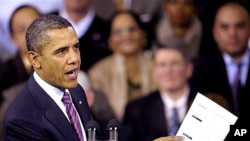



President Barack Obama has unveiled a plan to boost the economy by helping some homeowners refinance their mortgages. The initiative, announced Wednesday, would build on an earlier White House program.
Declining housing prices and widespread foreclosures are among the biggest drags on the U.S. economic recovery.
President Obama went to a neighborhood near Washington where home values have dropped sharply, to lay out his proposal to fight the problem.
“I am sending Congress a plan that will give every responsible homeowner in America the chance to save about $3,000 a year on their mortgage by refinancing at historically low rates," said President Obama.
The plan would expand a program that was intended for at least four-million homeowners to refinance their mortgages at lower rates, but reached only about one million.
Plunging home values have left an estimated 11 million Americans owing more than their homes are worth, according to one real-estate data firm. That amounts to one out of every four homeowners with a mortgage.
President Obama says the problem has been deeper than many experts and officials expected, and that it will not be solved quickly.
“It is going to take more time than any of us would like for the housing market to fully recover from this crisis," said Obama. "This was a big bubble. And when it burst, it had a big effect. Home prices started a pretty steady decline about five years ago.”
Some economists say Mr. Obama’s plan will not work. Cato Institute Financial Regulation Studies Director Mark Calabria says reducing mortgage rates helps the homeowner, but puts less money into the economy.
“But I am also lowering, at the same time, the interest payment that goes to the bondholder, the investor, whether it is a retirement fund or a pension fund," said Calabria. "So you are making one person wealthier with higher disposable income, but you are doing it at the same time that you are making another corresponding party poorer by the same amount.”
Calabria also says the initiative does nothing to address the top cause of foreclosure, which is job loss by mortgage holders.
The new program would cost between $5 billion and $10 billion. It would be paid for by a fee on large banks, a proposal Congress has previously rejected.
Obama Proposes More Help for Troubled US Homeowners
- By Kent Klein