



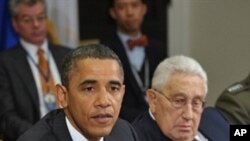
President Barack Obama is mounting an all-out push for U.S. Senate ratification of the New START nuclear treaty with Russia, calling it crucial for U.S. national security. The president summoned a bipartisan group of former White House officials to help efforts to gain ratification before the end of the year.
Seated with the president were Vice President Joe Biden, Secretary of State Hillary Clinton, along with the Democratic chairman and ranking Republican on the Senate Foreign Relations Committee, John Kerry and Richard Lugar.
Also there were former secretaries of state Madeleine Albright, James Baker and Henry Kissinger, former defense secretaries William Cohen and William Perry, former National Security Adviser Brent Scowcroft and former Senator Sam Nunn.
Calling ratification a national security imperative, the president said failure to do so would endanger the entire U.S.-Russian verification framework.
"If we do not, then we do not have a verification regime. No inspectors, no insights into Russia's strategic arsenal, no framework for cooperation between the world's two nuclear superpowers."
New START was signed earlier this year to replace the expired START treaty. It would reduce U.S. and Russian long-range nuclear arsenals by as much as one third and provide mechanisms for verification by both sides.
During his just-completed Asia trip, Mr. Obama told Russian President Dmitry Medvedev that achieving Senate approval is his top foreign policy priority.
Though it has broad bipartisan support, New START has faced resistance from Republicans, such as Senator Jon Kyl, who assert it would harm U.S. missile-defense efforts, and not allow for adequate U.S. verification of Russian compliance.
Saying arms control treaties have not traditionally been a partisan issue in Congress, Mr. Obama noted he agreed to add $4.1 billion to upgrade the U.S. nuclear weapons infrastructure, to address Republican concerns. Delay, he said, is not an option.
"This is not about politics, it is about national security. This is not a matter that can be delayed. Every month that goes by without a treaty means we are not able to verify what is going on, on the ground, in Russia. And if we delay indefinitely, American leadership on nonproliferation and America's national security will be weakened."
New START ratification also is an important part of the president's "reset" of relations with Russia. Mr. Obama linked the treaty to a range of other issues, including Moscow's support for sanctions against Iran, U.S. efforts in Afghanistan, securing vulnerable nuclear materials, and steps to enhance European security.
Senate ratification requires 67 votes in the 100 seat chamber where Democrats still hold a majority. When a new Congress convenes next year, Democrats would need to obtain the support of at least 14 Senate Republicans.
President Obama said he has assigned Vice President Biden to undertake a day-and-night effort to ensure that New START is ratified, adding he is confident in being able to get the Senate votes needed for ratification.