News / Europe

Obama Signs Russia Trade and Human Rights Bill

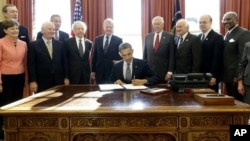
President Obama signs the Russia and Moldova Jackson-Vanik Repeal and Sergei Magnitsky Rule of Law Accountability Act Oval Office, Washington, Dec. 14, 2012.
TEXT SIZE - +
VOA News
U.S. President Barack Obama signed legislation Friday that normalizes trade relations with Russia, while imposing sanctions on Russian officials accused of violating human rights.
 
The U.S. Senate passed the bill last week, about three weeks after it cleared the House of Representatives. The bill combines two separate measures into one. The first part lifts trade restrictions on Russia dating back to the Cold War era. It also normalizes trade with Moldova. The second part denies visas and freezes the U.S. bank assets of suspected Russian rights violators.
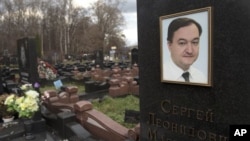
 
Tombstone of lawyer Sergei Magnitsky, who died in jail, at a cemetery in Moscow, Nov. 16, 2012.Tombstone of lawyer Sergei Magnitsky, who died in jail, at a cemetery in Moscow, Nov. 16, 2012.
x
Tombstone of lawyer Sergei Magnitsky, who died in jail, at a cemetery in Moscow, Nov. 16, 2012.
The bill is named after Sergei Magnitsky, a 37-year-old Russian anti-corruption lawyer who died in jail in 2009 after exposing what he called a criminal ring of officials who stole $250 million in tax money. The legislation is designed to target Russian officials involved in Magnitsky's detention, abuse or death.
 
The human rights portion of the act has drawn fierce opposition from Russia, with President Vladimir Putin describing it as "unfriendly and politicized" and promising an "appropriate response."
 
On Friday, Russia's parliament gave initial backing to a retaliatory bill that denies entry to U.S. citizens suspected of violating the rights of Russian citizens abroad. Lawmakers say they are considering naming the measure after Dima Yakovlev, a Russian boy who died after his U.S. adoptive family left him locked in a car.
 
Russian officials have expressed concern about the treatment of Russian children adopted by Americans. But Alexander Romanov of the World Links Adoption Agency says the criticism is unfair. He said statistics refute the allegations, saying the majority of the tens of thousands of Russian children adopted into American families grow up well and realize their full potential.
 
While the U.S. legislation's human rights provision has stirred controversy, views of the trade portion of the legislation are more positive. Influential business groups have urged U.S. lawmakers to normalize trade relations with Russia since Russia joined the World Trade Organization in August.
 
The U.S. must remove its trade barriers for American companies to receive all the market benefits from Russia's membership. Otherwise, business groups say the U.S. will fall behind China and other nations that have already formalized trade relations with Russia, and will not be able to resolve any trade disputes at the WTO with the world's ninth-largest economy.
 
Economists have predicted U.S. exports to Russia will double in five years if the barriers are lifted.

You May Like

Karzai to Discuss Enhancing Defense Ties with India

Afghanistan looking for more military aid as it prepares for withdrawal of NATO forces by next year More

India, China Pledge to Overcome Border Tensions

Indian prime minister and Chinese premier attempt to move past tense standoff in the Himalayas during Delhi talks More

Burmese President Opens US Visit with VOA Town Hall Meeting

Ahead of his meeting with President Obama Monday, Thein Sein answered questions on human rights and economic development in his country More

Featured Videos

Your JavaScript is turned off or you have an old version of Adobe's Flash Player. Get the latest Flash player.
Video

Video Valley Fever Raises Concerns in California, Arizona

A longstanding health problem in California's Central Valley has worsened in recent years, leading health officials to order the relocation of 3,000 prisoners from two state prisons. But the disease affects much of the population in some rural communities and, Mike O'Sullivan reports, while it often goes unnoticed, it sometimes can be devastating for patients.