


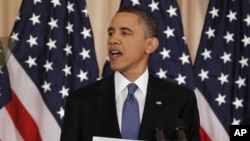
In his Middle East policy speech, President Barack Obama said Syrian President Bashar al-Assad faces the choice of either leading a democratic transition in his country or getting out of the way. The comment came a day after the U.S. administration imposed sanctions on the Syrian leader and key aides.
President Barack Obama's comments stopped short of an outright demand Syria's leader step down. But the remarks were another sign of diminishing U.S. patience with President Bashar al-Assad, whose reform promises have been contradicted by an ongoing brutal crackdown on protesters.
"The Syrian people have shown their courage in demanding a transition to democracy," said Obama. "President Assad now has a choice: he can lead that transition, or get out of the way. The Syrian government must stop shooting demonstrators and allow peaceful protests, release political prisoners and stop unjust arrests, they must allow human rights monitors to have access to cities like Daraa, and start a serious dialogue to advance a democratic transition."
President Obama said Syria has followed its ally Iran and sought assistance from Tehran in what he termed the "tactics of suppression." He said that speaks to the "hypocrisy of the Iranian regime," which he says professes support for the rights of protesters abroad, but suppresses its people at home.
On the eve of President Obama's speech, the administration announced new sanctions on Syria that for the first time directly target President Assad and key advisers.
The measures, which freeze any U.S. assets the Syrians may have and forbid U.S. business dealings with them, may have little immediate effect on al-Assad.
But analysts say the U.S. action has high symbolic value, and could lead to major hardship for the Syrian ruling circle if the European Union, as expected, follows the U.S. lead in expanding sanctions.
Middle East expert Robert Satloff, the executive director of the Washington Institute for Near East Policy, says the Obama language is an "important step" toward a flat U.S. demand for Syrian regime change, and says it is highly unlikely that al-Assad will heed calls for reform.
"I think the more powerful message is that the administration has begun what is an almost-inexorable move toward calling on Assad to leave," Satloff explained. "If the administration is indeed serious that the standard for Syria will be reform towards an open, democratic, human-rights-respecting government, or leave, I think it is absolutely improbable that Assad will meet that standard."
Satloff said whether or when U.S. policy moves to a demand for the president to step down depends largely on whether Syrian crowds continue to defy the regime. Satloff added that said by personally targeting Assad in sanctions, the Obama administration may be testing whether the Syrian army or political elite might be inclined turn against the President.
In his address, President Obama said unless the Syrian leader starts a process for democratic transition, "his regime will continue to be challenged from within and isolated abroad."