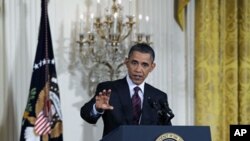



President Barack Obama on Wednesday held his first solo news conference since March, answering reporters' questions on issues ranging from Afghanistan and Libya, to the impasse with Congress over federal deficit reduction and raising the government's debt limit.
The news conference came amid public opinion polls showing Americans' frustration with a slow economic recovery, high unemployment, and difficult negotiations between Democrats and Republicans on reducing the government's deficit spending and raising the $14.3 trillion debt limit.
Mr. Obama elevated his role in the talks after Republicans walked out last week, objecting to Democrats' insistence on eliminating tax breaks for the wealthy as part of what Mr. Obama says must be a balanced deficit reduction package.
The deficit and debt issue dominated the news conference. Calling Republican positions "unsustainable," Mr. Obama said a potential U.S. default on obligations on August 2 would be "significant" and have "unpredictable" results.
The president addressed Republican assertions that he has not demonstrated enough leadership.
"When they decide they are not happy with the fact that at some point you have got to make a choice, they just all step up and say, 'The president needs to get this done.' They need to do their job. Now is the time to go ahead and make the tough choices. That is why they are called leaders," he said.
On the Senate floor earlier in the day, Senate Minority Leader, Republican Mitch McConnell, who met with Mr. Obama this week, criticized Democrats, saying that their main objective is to increase government spending.
"Democrats spend beyond their means and now they expect a bailout from the taxpayers. That is what this debate is really all about. It's about holding Washington accountable for a change," he said.
The president's news conference, which lasted a little more than an hour, came a week after he announced the start of a U.S. troop drawdown in Afghanistan and amid battles with Congress over legal justifications for U.S. involvement in NATO-led military operations in Libya.
On Afghanistan, Mr. Obama said the United States has been successful in decimating al-Qaida's leadership and ramping up training for Afghan government forces.
Asked about the attack on the Intercontinental Hotel in Kabul this week, the president said it is clear that similar events are bound to occur, but that the overall direction in Afghanistan is positive.
"We understood that Afghanistan is a dangerous place, that the Taliban is still active and that there are still going to be events like this on occasion. The question is, in terms of overall trend, is Afghan capacity increasing?," Obama said.
On Libya and the debate over consultation with Congress on U.S. military engagement there, Mr. Obama repeated his position that he has not been in violation of the 1973 War Powers Resolution because American operations are "limited in time and scope."
On Tuesday, the U.S. Senate Foreign Relations Committee approved a resolution that would authorize U.S. participation in NATO-led Libya operations for up to one year. But criticism of the president on Libya continues on Capitol Hill.
The president responded this way to a question about whether Americans should be prepared for prolonged military operations in Libya and what constitutes success.
"There is no doubt that [Libyan leader Moammar] Gadhafi stepping down from power is, from the international community's perspective, going to be the primary way that we can assure that the overall mission of Libya's people being protected is accomplished," Mr. Obama said.
Mr. Obama noted the International Criminal Court decision ordering Moammar Gadhafi's arrest on war crimes charges, and he pointed to reports of Libyan government troops engaging in "horrible acts," including possibly using rape as a weapon of war.
Mr. Obama was also asked about his position on same-sex marriage, in the wake of the recent vote by the New York state legislature approving a homosexual marriage bill.
The president, who was to hold a reception later for gay civil rights leaders, said he deplores discrimination based on sexual orientation, and that his administration has done more to advance gay rights "than the previous 43 presidents."
Obama Urges Lawmakers to Seize Moment, Tackle Debt