



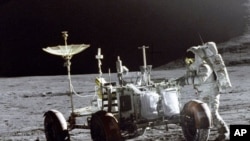
The U.S. space agency's ambitious plan to put astronauts back on the moon has been cancelled in the Obama administration's proposed 2011 federal budget. The $3.6 trillion spending plan for the U.S. government was submitted to Congress on Feb. 1.
NASA's budget would actually increase by $6 billion over the next five years under the plan. But that amount falls far short of what it would need to support the estimated $81 billion Constellation program, aimed at returning astronauts to the moon by 2020. The costly program has been fraught with budget overruns and delayed by technical challenges with the design and testing of NASA's new Aeries 1 launch vehicle.
Cuts could boost private interest in public space agency
At a Feb. 1 news briefing, NASA administrator and former astronaut Charles Bolden said the new budget reflects a more sustainable and ambitious path to manned space exploration. He said NASA will focus on developing innovative space faring technologies and systems in partnership with the private sector. "We intend to blaze a new trail of discovery and development. We will facilitate the growth of new commercial industries and we will expand our understanding of the earth, our solar system and the universe beyond," Bolden says.

That would mean the private sector would take over getting astronauts into low-earth orbit. Responding to questions about whether the industry is up to the task, Britton Alexander, president of the Commercial Spaceflight Federation, says the private sector has a long and successful history with NASA. It's the same industry that has been doing it for NASA for the last 5 years," he says. "So it's really a change in how they contract for those services and vehicles," Alexander says. He adds that NASA will set the requirements and, "oversee vehicle safety and the process before putting astronauts on top."
A commitment to expand research conducted in space
Bolden confirmed that 2010 will see the final five U.S. space shuttle missions and he renewed his agency's commitment to more fully use the International Space Station. "We're going to address practical medical questions about astronaut bone density and the effects of radiation, how we can reach destinations sooner to mitigate the effects on space travelers of long journeys," he says. NASA will also support a broad array of biological, materials and combustion research aboard the space station.
Analysts unclear on proposed budget's impact on jobs
Critics of the planned changes are concerned that 4,600 of 15,000 jobs at the Kennedy Space Center in Florida will be cut with the end of the Space Shuttle Program. Alexander expects many of those highly trained workers to find new jobs in private industry. He notes that a $6 billion item in the proposed NASA budget would support commercial manned spacecraft development that could create as many as 5,000 jobs, about a third of which would be in Florida. That's based on a program about half the size of what is being proposed by the administration. It would also spur job growth in Colorado, Texas and California, he says, at the same time that the program to go back to the moon would not have been creating jobs.
Among the items that will get a boost in the NASA budget is earth science research, a new orbiting carbon observatory to replace the one lost on launch last year, and investment in a heavy-lift launcher. In all, the proposed 2011 budget will provide NASA with about $100 billion over the next five years to support these initiatives. But it remains to be seen whether the elimination of the moon program will pass muster in the U.S. Congress, which has the final say on federal spending priorities.