



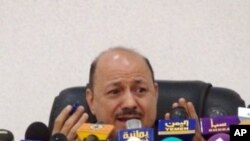
A top Yemeni official confirms that the Nigerian man suspected of trying to blow up an airplane last month met with an extremist Muslim cleric linked to other violence in the U.S. But the official says that although the suspect lived for a while in Yemen, he was radicalized in Britain.
Yemen's deputy prime minister for defense and security affairs says the suspect met with Anwar al-Awlaki, a cleric popular with extremist groups, late last year.
Rashad al-Alimi told reporters in Sana'a that Nigerian Umar Farouk Abdulmutallab is thought to have met with the American-Yemeni cleric in Shabwa. Yemeni forces carried out lethal raids against extremists in the southeastern province last month, but Alimi says it is not known if al-Awlaki was among those killed.
The cleric is believed to have influenced the U.S. military officer accused of killing 13 people at a Texas military base in November. Al-Awlaki preached at a mosque the suspect attended in Virginia. He was earlier based at a mosque in San Diego frequented by two of the terrorists who carried out the September, 2001 attacks in the United States.
But Deputy Prime Minister Alimi argued that the meeting in Shabwa with al-Awlaki came after the Nigerian suspect turned to extremism which he said didn't happen in Yemen.
Alimi says that Abdulmutallab had no contacts with radicals during his stay in Yemen in 2004 and 2005, but was exposed to extremist views during subsequent years in Britain.
Moreover, he argues that the British and U.S. governments failed to share important concerns about the suspect with Yemen, including a warning his father gave the U.S. embassy in Nigeria about his son's intentions. Alimi also denied claims, including by the suspect himself, that he received explosives training in Yemen.
All the same, Alimi had praise for both London and Washington, expressing gratitude for the international conference Britain is organizing later this month to address Yemen's problems, as well as U.S. promises of help in battling terrorists.
But the official ruled out any direct military intervention by the U.S., saying such interference could strengthen al-Qaida.
He also denied that Yemeni forces have been using U.S.-supplied drones to attack opponents, as some witnesses have reported.
The official's discussion of the various operations Yemen's forces are engaged in - a northern rebellion and a southern secessionist movement - also raised new questions about whether counter-terrorism efforts could be used to cover a wide array of activities.
Alimi referred to the Houthi fighters taking part in what is widely considered a tribal and sectarian battle in the north as terrorists. He also accused them of cooperating with the local al Qaida offshoot, an accusation at odds with what some Western military sources say has been the government's past use of al Qaida fighters in battling the Houthis.