



The arrival of oil-tainted waste to federally approved landfills across the Gulf coast is raising concerns are raised about the potential impact on the environment and public health
An estimated 700 million liters of oil have spilled into the Gulf of Mexico since the April 20th explosion of the Deepwater Horizon drilling rig.
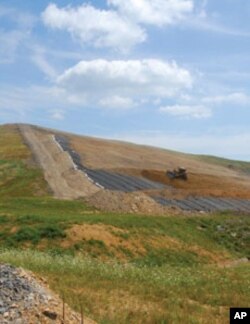
As the oil has spread and washed ashore at Gulf Coast beaches and wetlands, cleanup crews have been trying to scoop up what they can. The've collected tons of oily waste that's now being dumped in landfills in Alabama, Florida, Louisiana and Mississippi.
Residents and environmentalists worry about the long-term effects of the oily trash.
New waste entering landfills
People who live near waste landfills are accustomed to seeing trucks dumping normal household waste such as food, packaging, appliances, furniture and yard cuttings.
But the sight of workers wearing white protective suits and gloves hauling in tons of oil-contaminated waste - including bags of sandy tar balls, vegetation, used oil booms, rags and other clean-up supplies - has caused alarm among some Gulf coast communities. They're concerned about potentially toxic waste entering their local landfills.
The U.S. Environmental Protection Agency has agreed to allow BP, the British oil company responsible for the spill and its cleanup, to dispose of solid oil waste in approved landfills along the U.S. Gulf Coast.
No liquid oil waste will be dumped.
Protected sites
Jeremy O'Brien sees no problem with this strategy.
He is the director of applied research for the Solid Waste Association of North America, a professional organization that promotes the efficient and environmentally-sound management of municipal solid waste. O'Brien notes that composite liners underneath and above landfill waste offer protection to the environment. Additionally, two feet of clay under the liner offers increased protection to the groundwater.
"So the bottom portion of the landfill is designed to prevent any leachate that's generated by the landfill from exiting the landfill and contaminating the groundwater," says O'Brien. "They've been installed for the last almost 15 years now and tests show that they work very well."
Waste Management is a private company that operates several of the landfills that are receiving BP oil cleanup waste. Spokesman Ken Haldin says a combination of testing by BP, the Environmental Protection Agency and landfill operators, including Waste Management, should ensure that debris from the oil cleanup can safely be added to household waste in these facilities. He adds that landfills can easily accommodate the unexpected additional waste.
Like other kinds of trash dumped into landfills, the waste from the Gulf cleanup will eventually decompose, releasing a variety of gases and liquids which are vented or disposed of in turn. But in certain landfills, including some accepting the BP cleanup, waste, heat and methane gas produced by decomposition are being used to generate energy. Two hectares of treated landfill can generate enough electricity to power several thousand homes.
Best option
Still, there are potential hazards associated with dumping the Gulf oil waste into landfills.
Allen Hershkowitz with the Natural Resources Defense Council, a private environmental group, says air quality around landfill sites must be carefully checked when oil-contaminated waste is added to normal household trash.
According to Hershkowitz, no landfill liner system is completely leak-proof, meaning there is some possibility that the industrial quantities of waste coming from the oil cleanup could pollute local underground water supplies.
"So what this points out is that these types of oil disasters are not only posing risks to marine life and to fisheries and to the economy of coastal communities," he says. "They also pose long-term risks to those communities hosting the landfills where the oil saturated materials are being deposited."
Hershkowitz says, ideally, the Gulf cleanup's oily trash should be disposed of in an energy-producing furnace, but there are currently no facilities large enough to handle the volume of waste being generated by the cleanup efforts.
Another option, is to put the waste aside and dispose of it properly when resources are available. But the environmental waste expert concedes that for the time being, landfills are the only practical option.