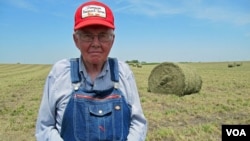
Iowa farmer Dick Thompson uses diversity to survive droughts and other natural disasters. (VOA/S. Baragona)
BOONE, Iowa — Unlike most of his Iowa neighbors, farmer Dick Thompson isn't expecting the US government to help him survive the drought.
While others depend upon federally subsidized crop insurance, Thompson relies on old-fashioned farming methods to see him through.
As drought scorches U.S. corn and soybean harvests, most American farmers protect themselves from major financial losses with federally subsidized crop insurance.
This year's insurance payouts are expected to top last year's $10.8 billion in damage from droughts and floods.
The federally backed program is the backbone of the farmer safety net Congress is considering as it debates the Farm Bill, an enormous five-year package of legislation encompassing agriculture and nutrition policy.
Thompson, 80, says he will see none of it.
"I have never bought crop insurance since we started to farm," he says.
On his own
Thompson also foregoes many of the tools of modern agriculture. He uses few chemical fertilizers and weed killers. He doesn't grow genetically modified crops.
"I'm old-fashioned and I'm proud of it," he says.
And yet, Thompson says his farm is more profitable than his modern-farming neighbors.
That success has inspired researchers like Matt Liebman at Iowa State University to study how farmers can succeed with such a contrarian approach.
"The reason we're doing this is because of what he's doing," Liebman says. His research fields at Iowa State University mimic much of what you find on Thompson's farm.
Diversity
One explanation is crop diversity, something lacking on many Iowa farms today.
Corn and soybeans carpet the Iowa landscape. Many farmers grow nothing else. And when those crops do poorly, as they will in this year's drought, payments from crop insurance keep farmers in business.
Instead of crop insurance, Thompson protects himself the old-fashioned way.
While he grows corn and soybeans, he also raises hay and oats, along with cattle and hogs.
His oat crop was harvested before the drought hit. His third crop of hay sits scattered in round, shoulder-high bales on what will be next year’s corn field.
"I think it's common sense," Thompson says. "You've got diversity and you've got some protection there. If one crop doesn't do well, maybe the other one will make up for the difference."
Losing ground
What Thompson calls common sense used to be common practice on Iowa farms.
But the amount of land used to grow hay is half what it was two decades ago. Oats have fallen by nearly 95 percent.
Livestock disappeared, too. The number of farms with cows decreased by half between 1982 and 2007. The number with hogs fell by more than 80 percent.
Thompson says that is a mistake. "If I'd sell the cows, I would be like everybody else around me, corn and [soy] beans," he says.
The livestock difference
Thompson will not sell off his herds because his cows and hogs are good for more than income. They also provide the manure to fertilize the soil, eliminating the need for chemical fertilizers.
Unlike many farmers, Thompson still raises livestock and says that's one of the keys to his success. (VOA/S. Baragona)
And the manure helps the soil hold water, another form of insurance in a drought, according to Iowa State University researcher Rick Cruse.
"It really adds to the condition of that soil that does favor crop growth, particularly under stress conditions," Cruse says. "And that's the kind of conditions we're experiencing this year."
And they are conditions farmers everywhere are more likely to face in the future with climate change.
Triple win
Matt Liebman says his research shows that Thompson has lessons for everyone.
"Looking toward diversity, crop-livestock integration, the careful stewardship of the soil, making the best use of every drop of rain that falls, those are lessons that we should know here. And they're even more important elsewhere," he says.
Thompson says it takes more work to farm this way than with chemicals and crop insurance, but he thinks it's worth it.
"I think it's a better way of taking care of the land and the environment and the pocketbook," he says. "You can have all three."
Thompson says the old-fashioned ways might still be the best.